GOP Learns Rural Loyalty Has a Sell-By Date
A new campaign quality-control unit discovers that a photo beside a combine is not the same thing as product stability.
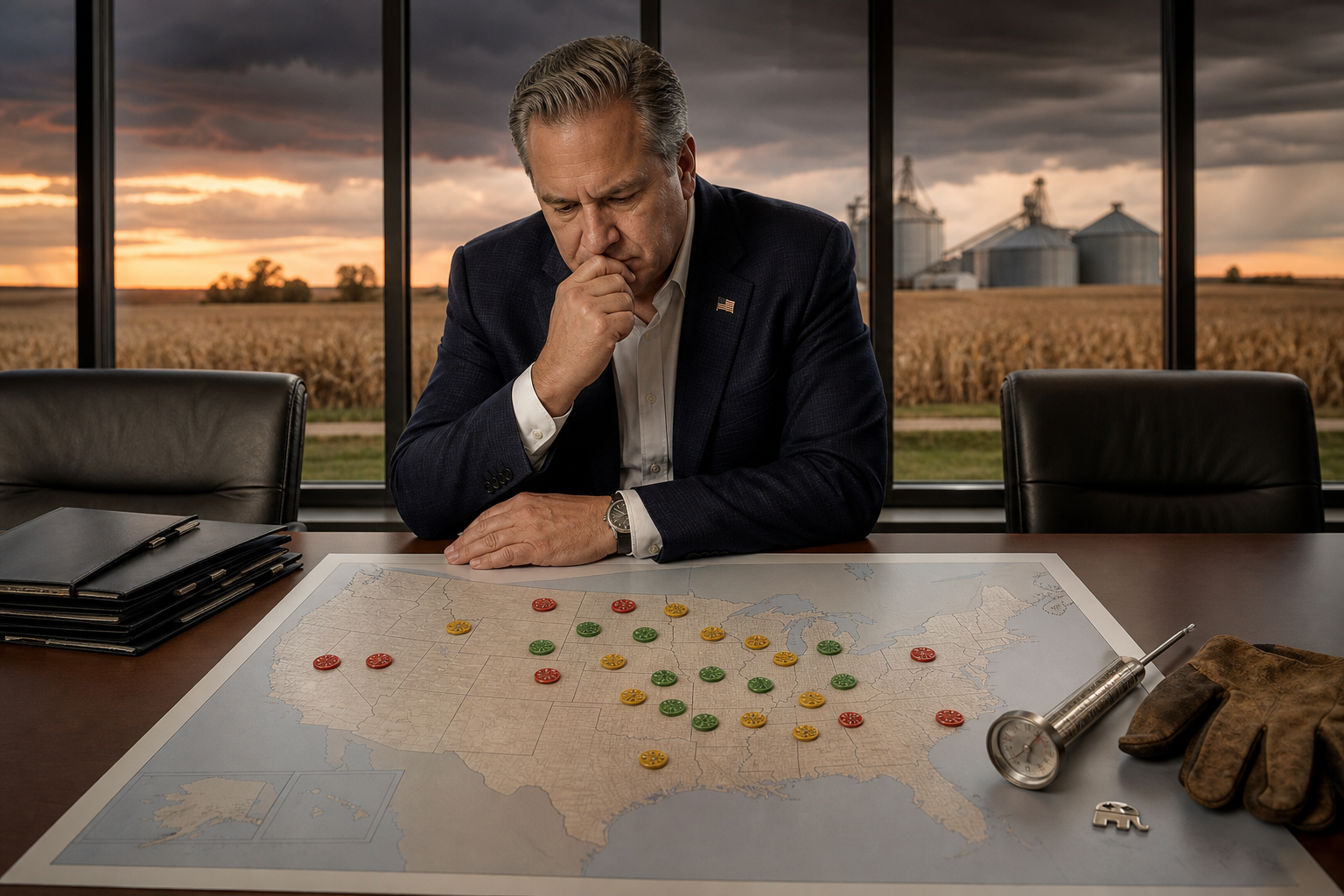
PARODY. Following a wave of farmer-funded ads hitting Republican candidates in rural battlegrounds, party officials have unveiled the Rural Loyalty Freshness Initiative, a nationwide quality-control program designed to determine whether a voter remains shelf-stable after being exposed to diesel prices, fertilizer costs, tariffs and the phrase “Save Our Bacon Act.”
The program began after campaign operatives noticed that several voters who had appeared enthusiastically behind candidates in flannel shirts were later found asking follow-up questions about policy. “We had classified rural support as ambient,” said one fictional GOP strategist, speaking beside a map marked with tiny thermometer icons. “Then somebody checked the temperature.”
Under the new system, every endorsement from a farm group will receive a freshness seal indicating how long it can safely be displayed in campaign materials before becoming misleading. A candidate endorsed in September may still use the endorsement through October, provided no new tariffs, fuel spikes, trade disruptions or congressional bacon legislation occurs within a 200-mile radius.
The seals have already caused problems. One incumbent reportedly arrived at a county fair carrying a laminated letter of support from an agricultural organization, only for a campaign aide to pull him aside and whisper that it had been stored beside three weeks of rising input costs.
“That endorsement was opened in a different economic environment,” the aide explained. “We cannot responsibly serve it now.”
The initiative’s first major finding was that farmers had been improperly categorized by national politics as scenery. For decades, campaigns had relied on a simple inventory system: locate grain elevator, place candidate near grain elevator, infer durable coalition. But the new farmer-backed ad campaign—aimed at Republicans in Iowa, Wisconsin, Pennsylvania and Colorado—revealed that farm voters may process animal-welfare rules, trade policy, household prices and federal spending as one long bill rather than as separate cable-news segments.
This has sent Republican message shops into a state of refrigerated alarm. Consultants had prepared two standard rural messages for the final stretch: “They don’t understand you” and “I was raised near a tractor.” Neither tested well against the new requirement that candidates explain why costs went up without pointing at a weather map, a foreign country or an intern holding a pie chart.
To solve the problem, the party hired produce-industry experts to inspect vulnerable candidates for signs of premature spoilage. The experts are not permitted to advise on policy. Their role is strictly visual and emotional: checking whether a senator has developed soft spots around the phrase “family farm,” whether a House member can survive being asked about export markets without immediately discussing freedom, and whether a candidate’s barn jacket has been worn long enough to acquire plausible creases.
Then came the more serious complication. The farmers funding the ads were not behaving like a conventional opposition group. They were also backing Republicans who opposed the federal bill at the center of the dispute. In other words, they had created the political development Washington fears most: an interest group with preferences.
“We believed every agricultural voter could be sorted into a broad rustic category,” said the fictional head of coalition logistics. “Now we’re hearing words like ‘specific bill,’ ‘regional market’ and ‘actual financial consequence.’ Frankly, we were not equipped for this level of agriculture.”
The party responded by issuing a new Rural Handling Guide. Candidates are instructed not to describe farmers as “the backbone of America” unless prepared to explain why the backbone has been carrying rising costs while Washington keeps asking it to smile for the ad. They are also cautioned against promising that a bill helps “all producers,” a phrase now considered legally equivalent to leaving potato salad in a hot truck.
By Wednesday, the program had reached its inevitable conclusion: rural loyalty could not be preserved through staging, packaging or repeated application of denim. It required the one ingredient political professionals had accidentally left out of the supply chain—farmers believing the people asking for their votes had noticed what their votes were paying for.
The emergency label was updated accordingly: Best before the next decision made on their behalf.
GOP Learns Rural Loyalty Has a Sell-By Date
A new campaign quality-control unit discovers that a photo beside a combine is not the same thing as product stability.
WHAT STARTED THIS MESS
The event underneath the joke is real. The SPILL premise, dialogue and escalation above are fictional parody.