Mike Collins Asks November 3 to Lower Gas Prices Before It Votes
Georgia’s Senate race enters its final week with one candidate placing the national energy market under the supervision of a Tuesday.
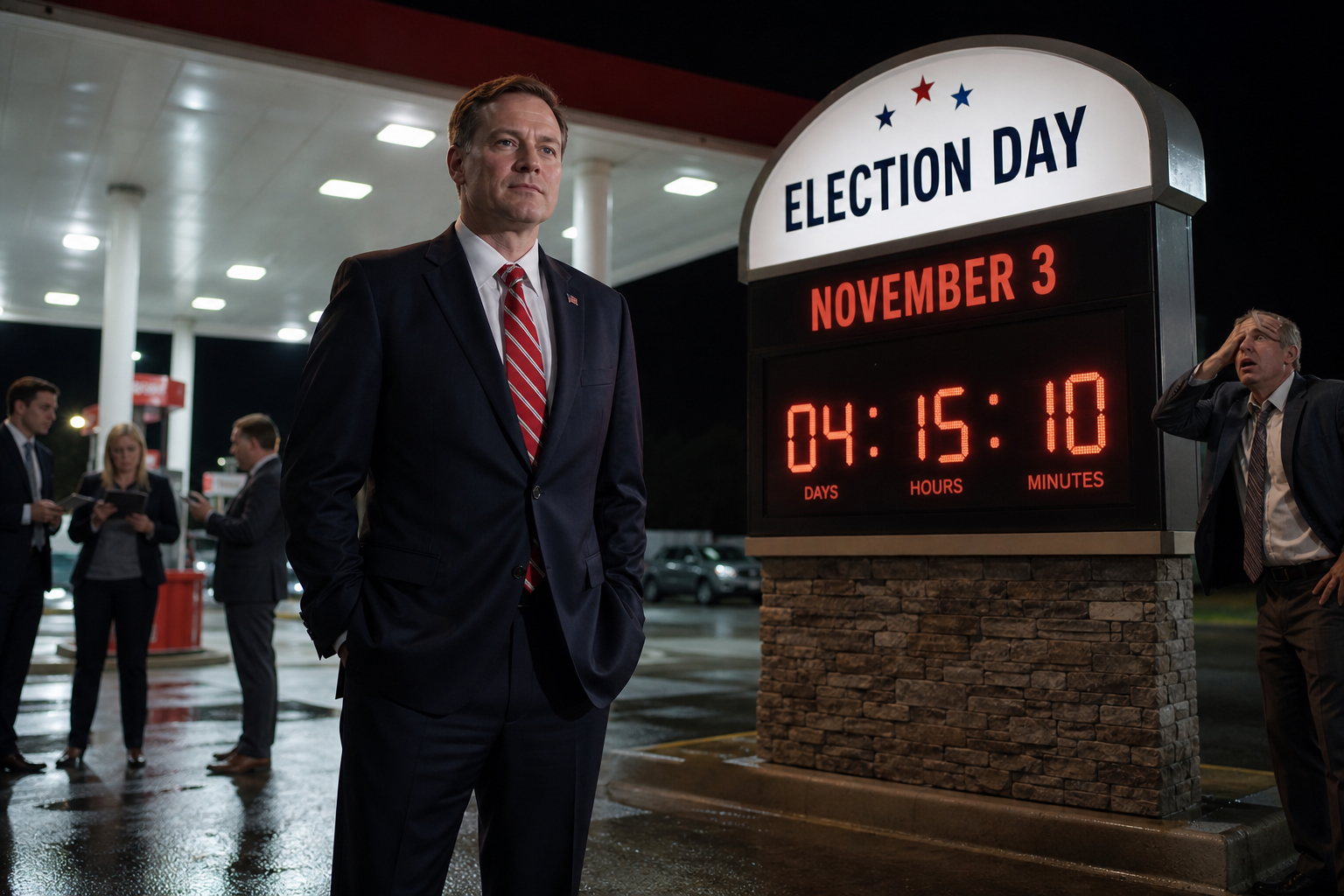
PARODY. With Georgia Republican Senate candidate Mike Collins predicting that fuel prices would fall after Election Day, November 3 was abruptly sworn in Wednesday as acting secretary of gasoline, diesel, truck-stop coffee and whatever that one blinking number means above the car wash.
The date, which had previously focused on being a Tuesday, said it was honored by the confidence but had not realized it would be expected to stabilize an international energy market before breakfast.
“I was planning to oversee some voting, produce a few tense county-map graphics, and then fade quietly into a pile of discarded yard signs,” November 3 said in a statement issued from a folding chair beside an elementary-school gymnasium. “Now apparently I have to negotiate with refineries, shipping lanes, petroleum futures and a guy in a pickup who believes a station owner can set prices by looking disappointed enough.”
Collins’ prediction created immediate logistical problems for the campaign calendar. Every other date now wants a role in economic management. October 31 offered to bring down candy prices if permitted to scare the Federal Reserve. November 4 requested authority over eggs, on the grounds that it will be “cleaning up an emotional mess anyway.”
December 24, long considered a reliable closer, said it could lower airfare only if the nation agreed to stop pretending it had not booked the trip twelve minutes ago.
Political consultants initially praised Collins for locating a fresh source of accountability outside the usual exhausted lineup of presidents, Congresses, central banks, oil-producing nations and basic supply-and-demand conditions. One Republican strategist described the move as “the kind of bold calendar-forward leadership voters have been asking for, mostly because nobody has asked them what it means yet.”
Within hours, November 3 had hired a chief of staff: 4:47 p.m., the most stressed moment of the date. The time immediately announced a national plan requiring gasoline prices to decline in every suburban precinct by exactly enough to make a televised panel say, “Well, that could matter.”
But the arrangement began to fray when Election Day learned that neither party had provided it with actual power over fuel costs. It had been given a ceremonial key to the economy, a commemorative pump handle, and a briefing binder titled Things That Are Definitely About to Get Better.
“They keep handing me charts with red arrows and asking whether I feel more affordable,” November 3 said. “I am a date. I cannot even move myself to Wednesday without causing a constitutional crisis.”
The date’s inability to command global markets alarmed campaign professionals, who had already booked it for a string of appearances at gas stations designed to look accidentally encountered by cameras. At one rehearsal, a campaign aide asked November 3 to stand beside an unleaded sign and project “kitchen-table relief.” November 3 asked whether that was before or after it fixed diesel prices for commercial trucking.
The deeper problem emerged when November 3 opened its inbox. It contained 11,000 messages from elected officials asking it to lower a different price by nightfall: rent, groceries, prescription drugs, interest rates, child care, auto insurance, burritos at airport kiosks and a suspiciously expensive bag of ice.
“This is not a date,” said an aide familiar with the calendar’s thinking. “This is an unpaid administrative assistant for every promise that became too vague to survive a follow-up question.”
By late afternoon, Election Day attempted to set boundaries. It would continue overseeing democracy, it said, but could no longer be held personally responsible for the cost of filling a tank, heating a home or purchasing a family-size package of cereal that now requires a financing plan.
That compromise lasted seven minutes. November 3 then received an urgent call from a Senate campaign asking whether it could make the price board at a Waffle House “feel more optimistic” before sunrise.
At press time, the date had lowered nothing but expectations, which consultants agreed was the first bipartisan accomplishment of the cycle.
Mike Collins Asks November 3 to Lower Gas Prices Before It Votes
Georgia’s Senate race enters its final week with one candidate placing the national energy market under the supervision of a Tuesday.
WHAT STARTED THIS MESS
The event underneath the joke is real. The SPILL premise, dialogue and escalation above are fictional parody.
- MS NOW Opinion | Why one Minnesota race could have massive national implications ↗
- FOX Michele Tafoya blasts 'historic fraud' in Minnesota amid tightening Senate race ↗
- CBS Michigan's deputy secretary of state talks election security as Senate race heats up ↗
- CNN Can Sen. Jon Ossoff’s influence extend to the Georgia governor’s race? ↗
- Reuters Michigan Senate race a test of attacks on Muslim candidate, progressive agenda ↗