Trump and Texas Win Best Original Lawsuit Against Themselves
The legal drama’s only casualty was the ancient custom of pretending both sides wanted different outcomes.
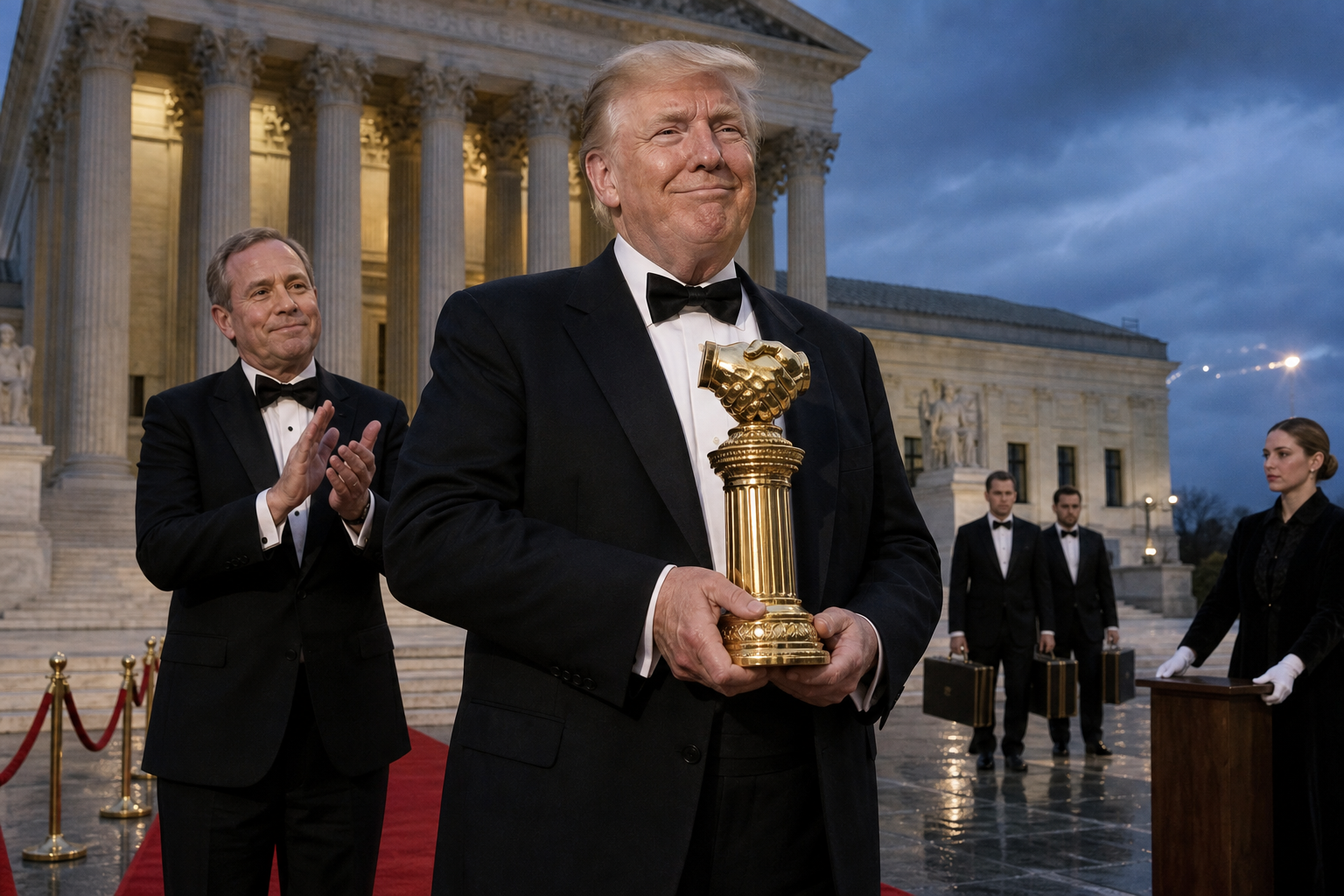
WASHINGTON— The Trump administration and the state of Texas celebrated their Supreme Court victory Tuesday by accepting the inaugural award for Best Original Lawsuit Against Yourself, an honor recognizing the rare legal production in which every principal performer arrived already knowing how the scene would end.
“This was a difficult process,” said a fictional Justice Department representative, holding a small bronze statuette of a courthouse embracing itself in a full-length mirror. “Texas had to sue us. We had to explain that we understood Texas completely. Then a judge had to listen to us agree at each other until the rule disappeared. The emotional range alone was extraordinary.”
The ceremony followed the Court’s decision not to immediately restore a Biden-era policy that had allowed immigration judges, in certain circumstances, to pause deportation proceedings while people pursued other forms of legal relief. In the fictional awards version, the ruling’s biggest winner was the Department of Justice’s Supporting Actor performance as an institution technically named in a lawsuit but spiritually seated beside the plaintiff.
Texas Attorney General Ken Paxton was said to have accepted the prize remotely from a soundstage dressed to resemble a federal courthouse, where he stood beneath a giant velvet banner reading: ADVERSE PARTIES, ONE VISION.
“People think lawsuits are about conflict,” Paxton said in the parody broadcast. “But sometimes they’re about two levels of government looking deeply into each other’s eyes and saying, ‘What if we skipped all that?’”
For decades, Americans have been taught that the legal system depends on opposing sides presenting competing arguments before an impartial judge. The new administration-Texas model, according to fictional campaign materials, offers a sleeker alternative: identify a regulation you dislike, find a state that dislikes it with sufficient lighting, and produce a limited series in which everyone discovers the policy is unconstitutional by Episode Two.
“It’s not collusion,” insisted the ceremony’s host, a tuxedoed litigation consultant who introduced himself only as “the guy who gets the complaint into final draft before anyone remembers to disagree.” “Collusion is secret. This was an open, transparent creative partnership between parties who happened to share a plaintiff, a defendant, a legal theory, a desired outcome and an allergy to administrative procedure.”
The evening hit its first awkward note when representatives from Baltimore, Columbus and New Haven attempted to enter the ballroom carrying folders labeled WE WOULD LIKE TO SAY SOMETHING. Security redirected them to the Standing Lounge, a windowless hospitality suite where guests could enjoy sparkling water and learn whether they existed in a sufficiently legal capacity to have concerns.
Inside, a giant screen replayed the season’s defining courtroom moment: the federal government’s lawyers declining to deliver the kind of fiery defense usually expected from the federal government’s lawyers. The audience rose for a standing ovation so sustained that one fictional appellate clerk began checking whether it counted as oral argument.
Then came the surprise upset. The award for Best Adapted Procedure went not to any judge, lawyer or state official, but to the phrase “notice-and-comment rulemaking,” which appeared by video feed from a quiet table near the back of the hall.
“I’d like to thank the many generations of federal employees who believed rules should be changed through public process,” the phrase said, visibly trying not to cry. “I was told this was a lifetime achievement award. I did not realize it was a farewell dinner.”
That brought the room briefly to silence. Even the administration’s fictional legal strategists seemed moved, mainly because none of them had budgeted for a monologue from administrative law.
By the end of the night, the winners posed for photos with their statuettes while a newly hired publicist reminded reporters that the project had required tremendous courage: not the courage to win an argument against a determined opponent, but the much rarer courage to file the paperwork before your collaborator accidentally develops an independent thought.
Trump and Texas Win Best Original Lawsuit Against Themselves
The legal drama’s only casualty was the ancient custom of pretending both sides wanted different outcomes.
WHAT STARTED THIS MESS
The event underneath the joke is real. The SPILL premise, dialogue and escalation above are fictional parody.
- Reuters First Venezuelan oil from US-NABEP deal arrives in Texas, to be sold to Exxon, Citgo ↗
- NPR Trump says he's ending restrictions on climate-warming methane from oil drilling ↗
- NBC Trump says he’ll roll back Biden-era methane rules for oil and gas companies ↗
- FOX Trump's unusual legal gambit against Biden-era deportation rule pays off at Supreme Court ↗