Supreme Court Declares Voter Confusion a Protected Election Tradition
Justice Ketanji Brown Jackson’s dissent is rejected after accidentally making the rules too understandable near an election.
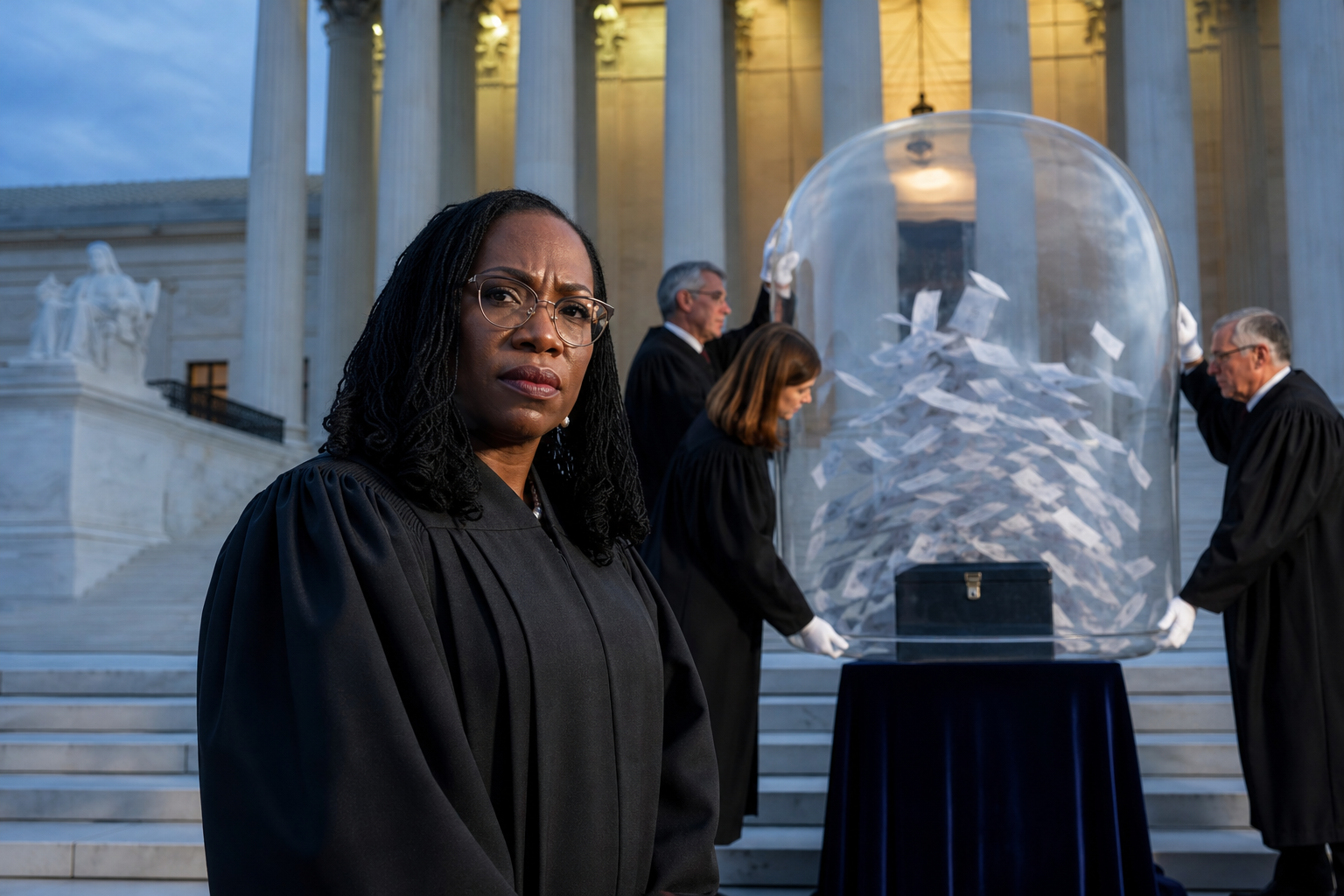
PARODY — In an entirely fictional order issued shortly after its real decision concerning New Hampshire student IDs, the Supreme Court announced Friday that voter confusion has been designated a protected election tradition and may not be meaningfully reduced within a reasonable distance of Election Day.
The Court’s new doctrine, Purcell v. Common Sense, protects the delicate period in which a voter knows there is a rule, suspects the rule may have changed, has been told the rule is simple, and is now standing at a kitchen counter surrounded by three documents, a dead printer and a government website that opens directly into an inspirational quote about democracy.
“The Constitution does not require elections to be easy,” said a fictional Court spokesperson, carefully lowering a glass case over a pile of contradictory county pamphlets. “It requires them to occur under conditions Americans recognize from childhood: last-minute instructions, unexplained exceptions and an uncle who insists he voted with a fishing license in 1987.”
The policy follows the Court’s real emergency order allowing New Hampshire to enforce its prohibition on using student IDs as ballot identification. In the parody version, the justices concluded that any effort to clarify the remaining rules too close to an election would constitute an impermissible disturbance of the electorate’s natural habitat.
“We have observed these voters in the wild,” the fictional order explained. “They are adapting beautifully. One has opened nineteen browser tabs. Another has developed a sophisticated taxonomy for the phrase ‘may be accepted.’ A third has become certain that a laminated card issued by an institution with the word ‘University’ on it is either unquestionably valid or an affront to civilization. This is civic resilience.”
Justice Ketanji Brown Jackson, the real-life lone public dissenter, was recast in the fictional proceeding as the Court’s sole opponent of the new preservation program. Her trouble began when she suggested that a lower court’s effort to ensure the public had accurate information about the state’s election process might be worth leaving alone.
That suggestion caused immediate alarm among the other fictional justices, who warned that voters exposed to accurate information could begin arriving at polling places with the unnerving calm of people who had planned ahead.
“If the public starts knowing what documents matter, where does it end?” asked one imaginary justice during oral argument. “Could they understand a deadline? Could they distinguish a statute from a secretary of state’s guidance? Before long, citizens will expect government to communicate its requirements before imposing them. That is not an election. That is customer service.”
New Hampshire officials, in the parody’s version of events, were assigned the delicate task of maintaining confusion at an artisanal level: enough that no one receives an unfair advantage from clarity, but not so much that anyone can accuse the state of hiding the rules. To accomplish this, the secretary of state’s office unveiled a new public-information standard called “helpful ambiguity.”
Under the program, every election notice begins with a warm assurance that eligible voters should participate, followed by a branching diagram that asks whether the voter’s identification was issued by a government, a school, a government-adjacent school, a school-shaped government, or a person in a reflective vest whose authority “felt official at the time.”
But the initiative encountered its first crisis when a group of election lawyers accidentally translated the rules into a single clear sentence. The statement was immediately quarantined in a password-protected PDF and marked FOR HISTORICAL RESEARCH ONLY.
“We cannot have useful knowledge breaking out days before a national election,” said a fictional preservation officer. “That is precisely the kind of disruption the Court was trying to prevent.”
The Court then announced a companion program allowing states to preserve other endangered democratic experiences, including the moment a voter learns that a deadline was yesterday, the ceremonial phone call to a county office that closes at 4:30, and the ancient American art of discovering one’s registration status through a website designed by an escaped vending machine.
Jackson, according to the parody order, requested that the Court at least distinguish between changing an election rule and explaining which rule is currently in effect. Her colleagues declined, saying such distinctions had the dangerous tendency to make the public feel briefly respected.
By evening, the marble plaza outside the Court had been fitted with a bronze historical marker commemorating the nation’s newest protected institution: the exact moment a citizen whispers, “Wait, what?”
Supreme Court Declares Voter Confusion a Protected Election Tradition
Justice Ketanji Brown Jackson’s dissent is rejected after accidentally making the rules too understandable near an election.
WHAT STARTED THIS MESS
The event underneath the joke is real. The SPILL premise, dialogue and escalation above are fictional parody.
- MS NOW Opinion | Hillary Clinton thinks we should have 13 Supreme Court justices. Here’s why that matters. ↗
- CBS Supreme Court rules New Hampshire can ban use of student IDs for midterm voters ↗
- FOX Jackson again publicly breaks with Supreme Court as justices side with GOP in last-minute voter ID fight ↗
- CNN A GOP congressman in a swing district faces angry voters: ‘I’m against the party that caused this’ ↗