White House Lets Grocery Aisles Set Canada Trade Policy
The new tariff system asks only one question: can this product make a congressional district feel something?
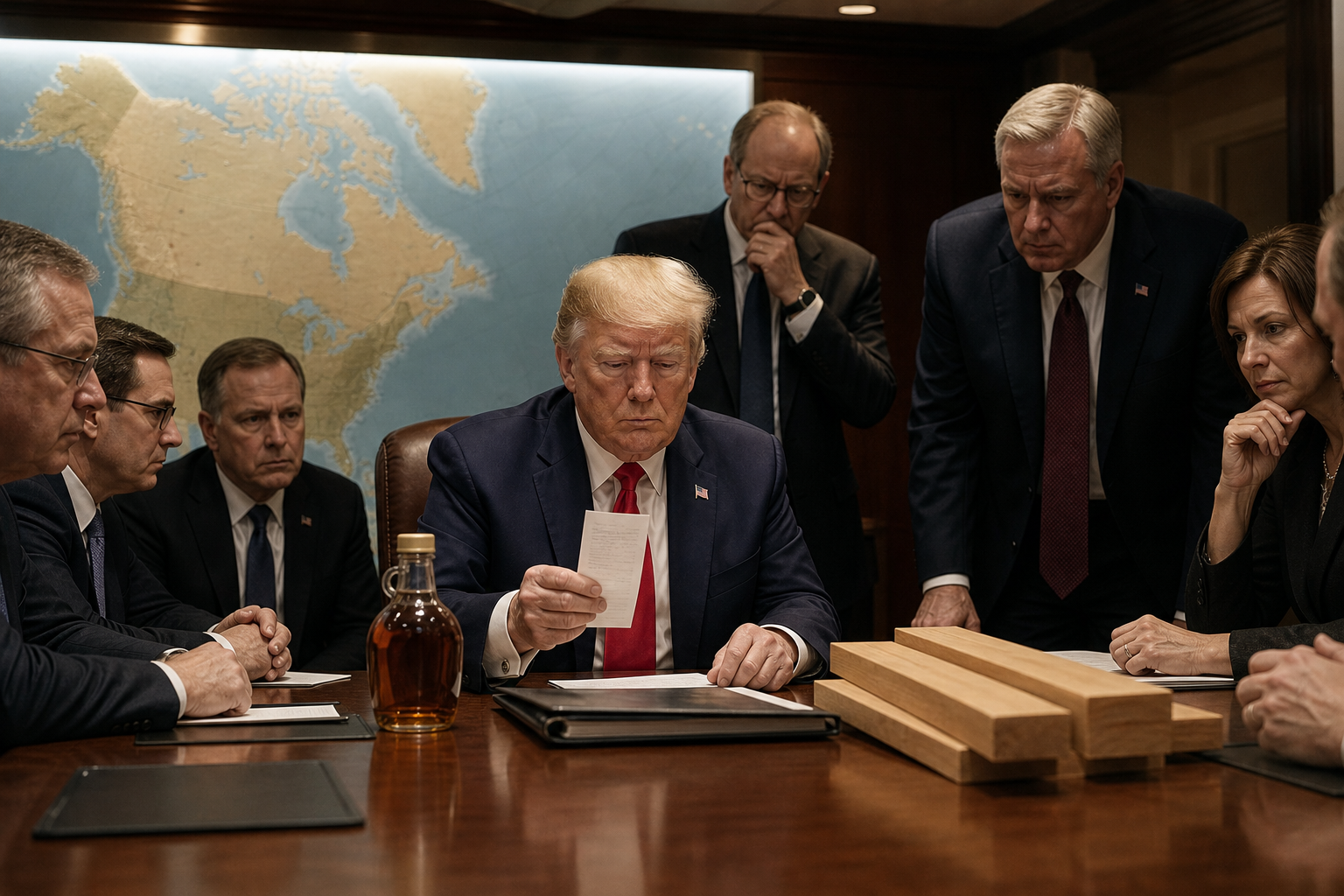
PARODY. The White House announced Friday that Canadian trade policy will now be determined by a new interagency body called the Grocery Aisle, a 14-person task force empowered to suspend tariffs whenever a product begins looking emotionally competitive in a congressional district.
The program, known internally as Price Match America, was created after officials reportedly considered removing some 50% tariffs on Canadian goods to help Republicans facing voters who had developed an unfortunate habit of noticing prices without first consulting the macroeconomic briefing book.
“We used to make trade decisions based on supply chains, strategic industries and national interest,” said a fictional senior official, standing before a wall of unlabeled supermarket receipts. “Then we learned that a jar of pasta sauce can apparently have a county-level political identity.”
Under the new system, every imported Canadian product receives a “Voter Sensitivity Score” before entering the country. Lumber, aluminum and fertilizer will continue through the traditional process of hearings, legal reviews and diplomatic negotiations. But anything that appears near a household staple, a backyard project or a televised cookout may be rushed directly to the Oval Office, where aides will place it beside a map and wait for the president to ask whether it “plays in the suburbs.”
The first emergency tariff review involved a Canadian product described only as “something people keep mentioning at warehouse clubs.” Trade lawyers spent six hours arguing over its classification while campaign advisers monitored whether the phrase “this is getting ridiculous” was being used with enough sincerity to justify an exemption.
“The country cannot be held hostage by retail vibes,” protested one fictional Commerce Department economist, before being told that retail vibes had already been assigned a deputy chief of staff.
The arrangement initially pleased everyone. Republican candidates were promised relief from prices that had begun appearing in their local television ads. Canadian officials were offered the rare dignity of being treated not as a sovereign trading partner but as a coupon whose expiration date depends on polling. And the White House could describe every reversal as proof that its economic policy was agile, responsive and in no way reacting to the same groceries as everybody else.
Then the Canadians discovered the scoring system.
Within hours, Ottawa began submitting tariff-relief applications for products with increasingly creative electoral profiles. A filing for maple syrup argued that its removal would strengthen family breakfast, tourism, national unity and “the morale of any senator filmed near pancakes.” Another requested immediate protection for hockey equipment on the grounds that no elected official wishes to explain why a child’s first slap shot became a geopolitical sacrifice.
By lunchtime, the administration had received a 900-page Canadian analysis demonstrating that virtually every item exported south of the border could, under the right lighting, become a kitchen-table issue in a competitive district.
The White House answered with a rule: only products that create “authentic voter concern” qualify. This produced a new problem when campaign consultants began conducting focus groups in which participants were shown ordinary household goods and asked whether they felt abandoned by civilization.
One group was reportedly presented with a bag of potting soil, a modest tariff estimate and a photograph of a closed factory from 1987. By the end of the session, voters had concluded the soil was either a dangerous foreign dependency or a symbol of domestic renewal, depending on which consultant spoke last.
That was when the task force’s purpose quietly changed. It was no longer deciding whether tariffs should come off Canadian goods. It was deciding which emotion tariffs were supposed to produce.
Hardliners wanted certain prices kept high enough to demonstrate resolve. Political operatives wanted them lowered enough to demonstrate care. Trade officials asked whether a policy could be both punitive and affordable. The answer, after a long pause, was to schedule a rollout featuring a flag, a factory backdrop and no close-up shots of receipts.
By evening, the Grocery Aisle had issued its first guidance: tariffs may be adjusted whenever the public experiences a sufficiently bipartisan form of sticker shock, provided the adjustment can be described as a victory over the policy that caused it.
The task force will reconvene Monday, unless the eggs start polling.
White House Lets Grocery Aisles Set Canada Trade Policy
The new tariff system asks only one question: can this product make a congressional district feel something?
WHAT STARTED THIS MESS
The event underneath the joke is real. The SPILL premise, dialogue and escalation above are fictional parody.
- NBC North Carolina Midterm Elections 2026: Key Races, Candidates and Past Results ↗
- CNN Growing concern in Georgia over potential federal intervention in midterms ↗
- CBS How and when to vote early in Maryland's 2026 midterm elections ↗
- MS NOW Mike Barnicle: Midterm elections are not forecasts, they are verdicts ↗
- AP West Virginia investigates climate, environmental groups over alleged ‘deceptive’ acts ↗
- Reuters US to remove 50% tariffs on some Canadian goods to help Republicans in midterms, WSJ reports ↗