Congress Accredits Suspicious Letters as Capitol Press Corps
The envelopes will receive front-row briefing seats, protected-source status and the power to make every official sound guilty by lunchtime.
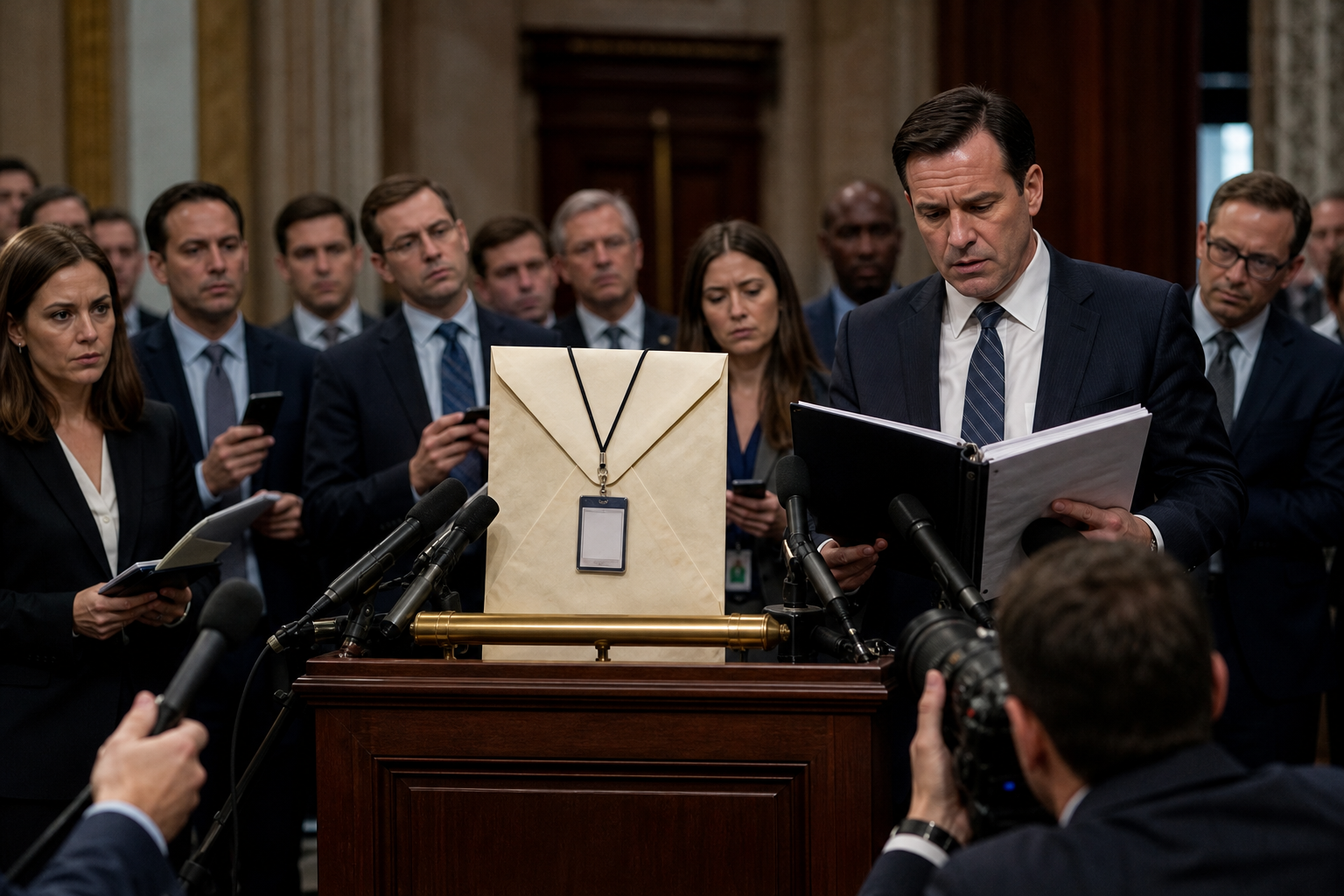
WASHINGTON—Following a wave of suspicious letters sent to election officials and congressional offices, congressional leaders announced Tuesday that the mailings would be formally recognized as members of the Capitol press corps, citing their extraordinary ability to dominate a news cycle while providing absolutely no usable information.
Under the fictional arrangement, each sealed envelope will receive a press credential, a folding chair in the briefing room and the same professional courtesy currently extended to any Washington institution capable of making an official say, “I can’t comment on an ongoing situation.”
“For years, we have asked journalists to identify themselves, state their outlet and occasionally remain awake through a subcommittee hearing,” said a fictional House administrator, gesturing toward a cream-colored envelope in a tiny lanyard. “These letters have no outlet, no byline, no questions and no apparent interest in basic democratic procedure. Frankly, they understand the assignment better than most of us.”
The envelopes quickly became fixtures of the capital’s political ecosystem. At the morning briefing, reporters waited as the newest accredited letter was placed on a podium beside the presidential seal. It did not ask whether the administration had a plan. It did not demand records. It simply sat there, forcing every official in the room to develop the facial expression normally reserved for a senator who has just learned a microphone was still on.
Election offices, meanwhile, were told the new credentialing process would not interfere with their actual work. A fictional memo assured administrators that the nation remained committed to safe, functional elections and that any disruptions would be handled with the seriousness normally afforded to a cable-news panel discovering an anonymous source has opinions.
That promise lasted until the letters began filing their own stories.
Because no one could establish what a sealed envelope thought, political operatives rapidly began interpreting its silence for it. One consultant told reporters that an envelope received in a Midwestern election office was “clearly expressing deep concern about turnout dynamics.” Another insisted an unopened mailing to a Senate office showed “real momentum” for his client’s message discipline.
By afternoon, three campaigns had released statements praising the letters for “asking the hard questions,” despite the letters having asked nothing at all. A fourth campaign launched a digital ad accusing its opponent of refusing to address “the envelope in the room.”
The breakthrough came when the Capitol press gallery granted the mailings protected-source status. Under the rule, officials could not ask who sent them, what they contained or why they had arrived, but were expected to organize their schedules around their implications.
“This is an enormous victory for source protection,” said a fictional gallery representative. “A source has never been more protected. It is protected from attribution, scrutiny, context, accountability and, in several cases, being touched by anybody with the appropriate training.”
The decision created an immediate conflict with Congress, which had spent decades insisting that important communications be opened only after passing through several committees, a metal detector and an intern named Caleb. Now lawmakers found themselves competing with the envelopes for airtime.
At a Senate hearing on election security, one chairman attempted to restore order by asking a credentialed letter whether it wished to submit testimony for the record. The envelope offered no response, which commentators immediately called its strongest performance of the year.
Election officials were less impressed. In the fictional version of events, they reminded Washington that their job was to conduct elections, not serve as unwilling supporting characters in a capital-wide pageant about who could look most concerned beside a closed flap.
Congress responded by promising an urgent bipartisan task force on mailroom optics, co-chaired by two senators who had never met an actual election administrator but had both appeared on television within the hour.
By evening, the nation’s newest press corps had already been invited to the annual correspondents’ dinner, where every envelope will be seated near the exit and praised for refusing to reveal whether it plans to attend.
Congress Accredits Suspicious Letters as Capitol Press Corps
The envelopes will receive front-row briefing seats, protected-source status and the power to make every official sound guilty by lunchtime.
WHAT STARTED THIS MESS
The event underneath the joke is real. The SPILL premise, dialogue and escalation above are fictional parody.