Trump Makes Ambassadors Responsible for Whatever He Hates Reading
The new State Department standard asks diplomats to protect American interests, strategic alliances and, above all, the president’s morning mood.
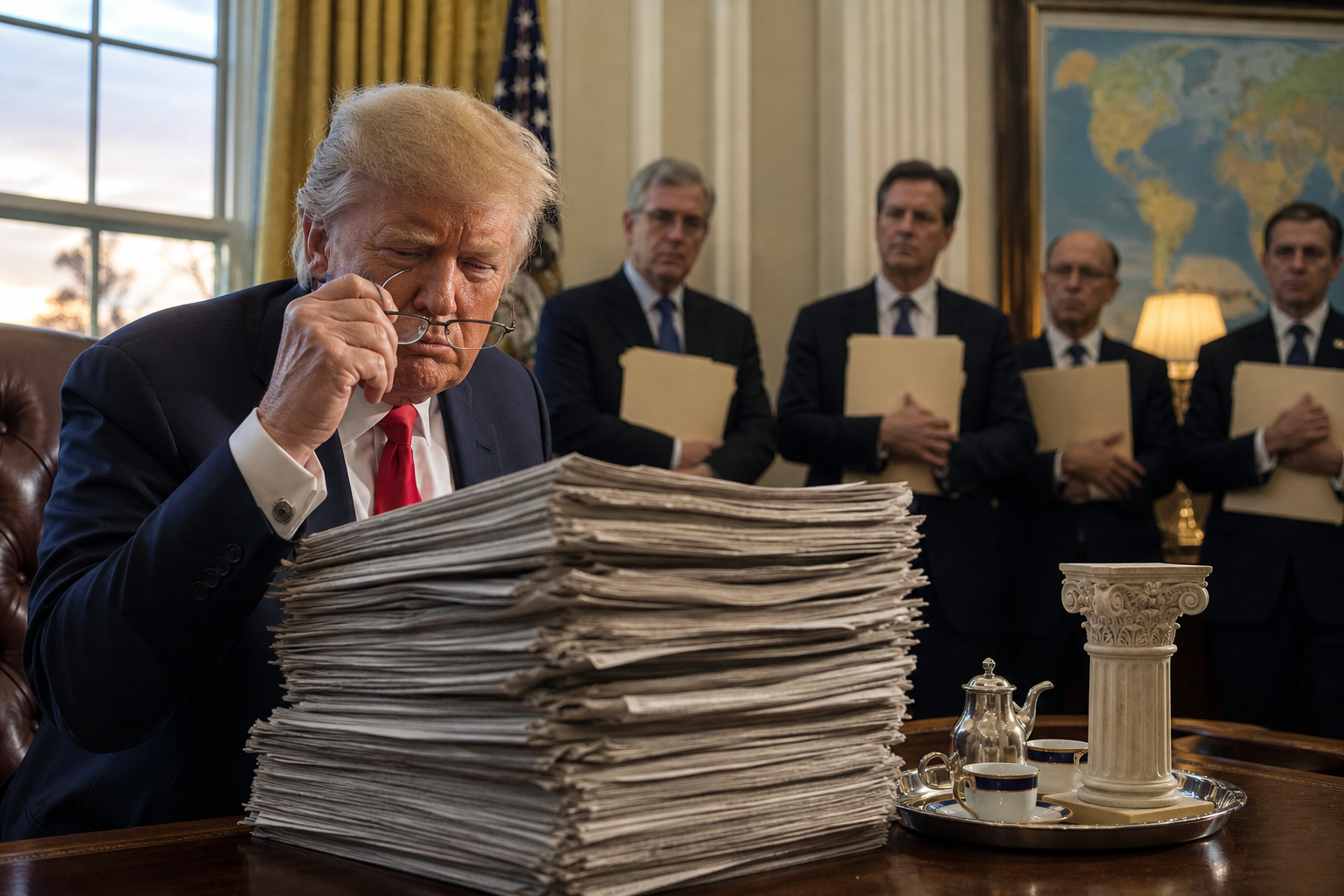
WASHINGTON — This is a work of parody inspired by real events.
Following Kimberly Guilfoyle’s resignation as U.S. ambassador to Greece, the White House has reportedly unveiled a new diplomatic standard designed to prevent future personnel embarrassments: every ambassador must now ensure that the president never encounters a story about them he does not enjoy reading.
The program, called the Presidential Reading Comfort Standard, replaces the State Department’s traditional emphasis on regional expertise, bilateral relations and knowing where one’s country is on a map. Under the new rules, ambassadors will be evaluated according to a simpler question: Could this situation have remained pleasantly theoretical until lunch?
“An ambassador’s job is to represent America abroad,” said a fictional White House aide, carefully placing a newspaper inside a sealed evidence bag. “But America’s interests are broad. They include defense cooperation, trade, democracy, and the sacred right of a president to pick up a phone without seeing his own administration described using the word ‘allegations.’”
Officials said the standard will be applied through a color-coded system. Green-level ambassadors may attend ceremonial dinners, negotiate military agreements and appear in photographs near ancient buildings. Yellow-level ambassadors may still conduct diplomacy, but only from rooms containing no mirrors, donors, luxury luggage or people with a podcast. Red-level ambassadors must immediately begin speaking in the past tense about their own careers.
The departure of Guilfoyle, who denied the allegations against her, created what one fictional State Department official called “an intolerable ambiguity in the chain of command.” For years, diplomats had understood that they answered to the secretary of state, the president and occasionally whichever congressional committee had discovered a microphone. Now they must also answer to the president’s reading experience, a jurisdiction with no boundaries and an extremely aggressive push-notification system.
Embassies were quickly instructed to begin submitting Daily Narrative Forecasts. The cable from Athens reportedly included routine assessments of shipping lanes, energy projects and Turkish-Greek relations, followed by a new mandatory section titled: Would This Be Annoying If Read Aloud Near a Helicopter?
Greece, meanwhile, was said to be concerned that Washington might view the vacancy as a sign of diminished interest in the alliance. The White House reassured Athens that the relationship remains “very important, very historic and currently not making anybody squint at a headline,” which diplomats described as the strongest bilateral guarantee offered by the administration to date.
The policy soon produced complications. Ambassadors began asking whether they could still tell foreign governments bad news if the news might later be reported accurately. One envoy sought guidance on whether a coup, a debt crisis or an unflattering restaurant review required advance clearance from the White House reading desk.
“We used to distinguish between intelligence and publicity,” said a fictional career diplomat, staring through a window at the Potomac with the thousand-yard gaze of someone who has just been asked to make sanctions less searchable. “Now every cable has to include a spoiler warning.”
The first internal test came when a senior official suggested that ambassadors might avoid trouble by behaving with exceptional caution. The idea was rejected as insufficiently scalable. Instead, State Department leadership is developing a personality-neutral diplomatic method known as Strategic Unnoticeability.
Under Strategic Unnoticeability, ambassadors are encouraged to enter a room, strengthen a defense partnership, secure energy access, reassure allies and leave before anyone learns their middle initial. They may not form friendships with anyone who owns a yacht, has ever used the phrase “private dinner,” or considers a text-message thread a legally adjacent memoir.
Critics within the fictional department worry that the policy could discourage ambitious people from serving overseas. The administration says that is precisely why it is working. “The ideal ambassador,” explained the aide, “has enough charisma to make a foreign capital feel respected, but not enough charisma to become a six-part investigative series.”
By late afternoon, the new standard had already been expanded across government. Cabinet officials were asked to submit reading samples. Agency heads were ordered to identify any friendships that might acquire italics in a magazine profile. The National Security Council established an emergency unit to distinguish between a developing international crisis and a story the president might call “not good.”
At the State Department, a final cable reminded all personnel that America’s alliances remain enduring, its commitments remain firm and its foreign service remains dedicated to advancing national interests with professionalism.
Then, in smaller type, it asked everyone to please stop giving the Odyssey a sequel.
Trump Makes Ambassadors Responsible for Whatever He Hates Reading
The new State Department standard asks diplomats to protect American interests, strategic alliances and, above all, the president’s morning mood.
WHAT STARTED THIS MESS
The event underneath the joke is real. The SPILL premise, dialogue and escalation above are fictional parody.