Roy Moore Appeal Inspires Supreme Court’s New ‘Please State Your Malice’ Rule
Political ads may now continue misleading voters, provided their creators describe the misleading in a sufficiently reflective tone.
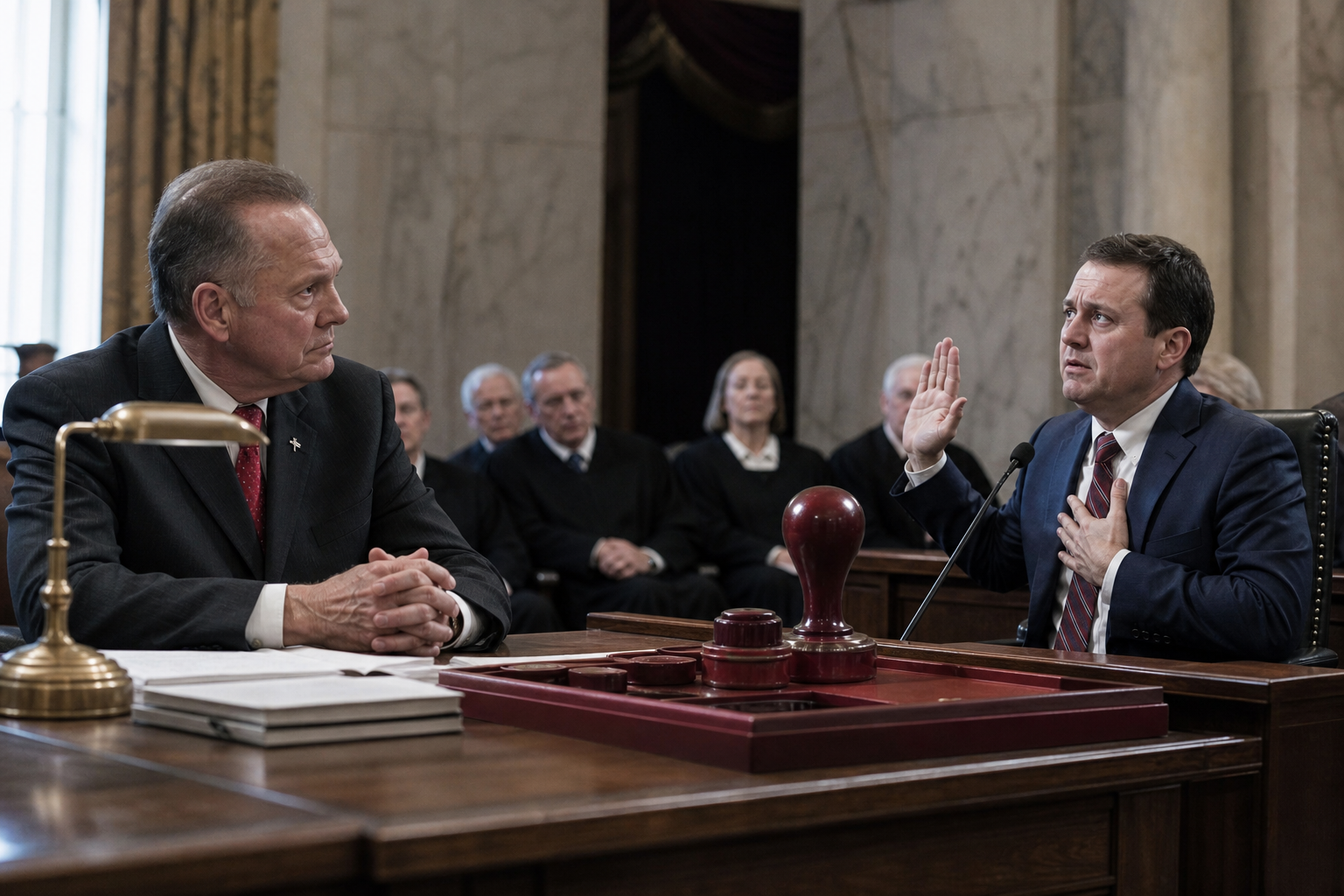
WASHINGTON—In a development that exists only in parody, the Supreme Court has unveiled a new compliance system requiring every political ad to pause halfway through and ask its creators to state, under oath, whether they knew what they were saying was false, probably false, emotionally false, vibes-based, or simply produced after a consultant said the word “devastating” three times.
The fictional rule, known as the Please State Your Malice Standard, follows the Court’s real decision not to take up Roy Moore’s effort to restore an $8.2 million defamation verdict connected to a 2017 Senate campaign ad. The new parody procedure is meant to resolve the famously intimate legal question of what a political speaker actually believed at the exact moment they decided to put ominous piano music under a sentence about their opponent.
Under the system, an ad cannot air until the strategist responsible appears in a quiet, softly lit video confession. “At the time of publication, did you believe this claim was false?” an unseen clerk asks. “No,” says the strategist. “Did you seriously doubt it?” “Not seriously. We were on a bus.” “Did anyone tell you it was untrue?” “Our research director made a face, but she makes that face whenever democracy happens.”
Campaigns initially objected that the rule would chill speech, mostly because no one in modern politics has ever been trained to identify a thought before converting it into a six-figure media buy. Within hours, however, the industry adapted. One Republican consultant unveiled a black turtleneck and a 90-second “intent statement” in which he stared into the middle distance and explained that his client’s claim had not been factually asserted so much as “released into the national conversation with great confidence.”
Democratic firms quickly followed with a series of ads carrying a tasteful disclosure at the bottom: Prepared without conscious knowledge of falsity, though possibly with several unread tabs open.
The Court’s first problem arrived when campaign lawyers discovered that candor itself could become evidence. A consultant who admitted, “We knew the claim was shaky, but the focus group laughed,” was immediately flagged by the new system’s red-light malice detector, a program designed by three former appellate clerks and one man who used to write terms-of-service updates for a rideshare company.
That forced the Court to issue a clarifying parody order: political professionals may describe their intentions only through “reasonable internal weather.” Ads may therefore be certified with statements such as, “At publication, our office experienced scattered uncertainty, with pockets of aggressive confidence moving in from the donor class.”
The innovation has already transformed television. Viewers in Alabama, Wisconsin and Pennsylvania now see attack ads interrupted by the people who made them, seated at tiny witness tables beside a bowl of breath mints. One ad accusing an opponent of being weak on border security pauses just before the grainy black-and-white footage to reveal its producer whispering, “I do not know what this bridge is. I have never been to this state. The bridge tested extremely well.”
Unexpectedly, voters have responded warmly. Polling from the fictional Institute for Democratic Self-Awareness found that citizens trust a political message 18 percent more when its sponsor openly admits to being unable to remember whether a central allegation came from an article, a screenshot, a cousin’s group chat or “something our candidate kept saying in the SUV.”
That success created a new crisis for the Court: campaigns began hiring professional sincerity coaches. Consultants now spend entire afternoons learning to say “I believed it in the moment” without looking like they are auditioning for a true-crime documentary. One super PAC reportedly tested five versions of an apology before deciding the most legally durable emotion was “mildly disappointed hotel manager.”
Roy Moore’s fictional contribution to the new system came in the form of a handwritten request that political advertisers be required to include a receipt for every claim, every source, every edit, every ominous piano chord and the full legal name of whichever staffer first suggested putting a candidate’s face next to an empty playground.
The Court declined that proposal, explaining that it would impose an intolerable burden on political speech and, more urgently, force America to discover who has been paying for the piano.
Roy Moore Appeal Inspires Supreme Court’s New ‘Please State Your Malice’ Rule
Political ads may now continue misleading voters, provided their creators describe the misleading in a sufficiently reflective tone.
WHAT STARTED THIS MESS
The event underneath the joke is real. The SPILL premise, dialogue and escalation above are fictional parody.
- NPR Iraq's Iranian-backed militias say it'll cease attacks once U.S. military withdraws ↗
- AP Soldier injured during Iranian attack says colleagues had to Google where to find the nearest hospital ↗
- CBS Supreme Court's new term begins today. Here's what to know. ↗
- PBS NewsHour Supreme Court rejects Roy Moore's push to restore $8.2 million defamation verdict awarded to him - PBS ↗