Trump White House Calls $6 Diesel America’s Down Payment on Presidential Resolve
In the new arrangement, the president accumulates courage equity while the country absorbs an adjustable-rate monthly payment.
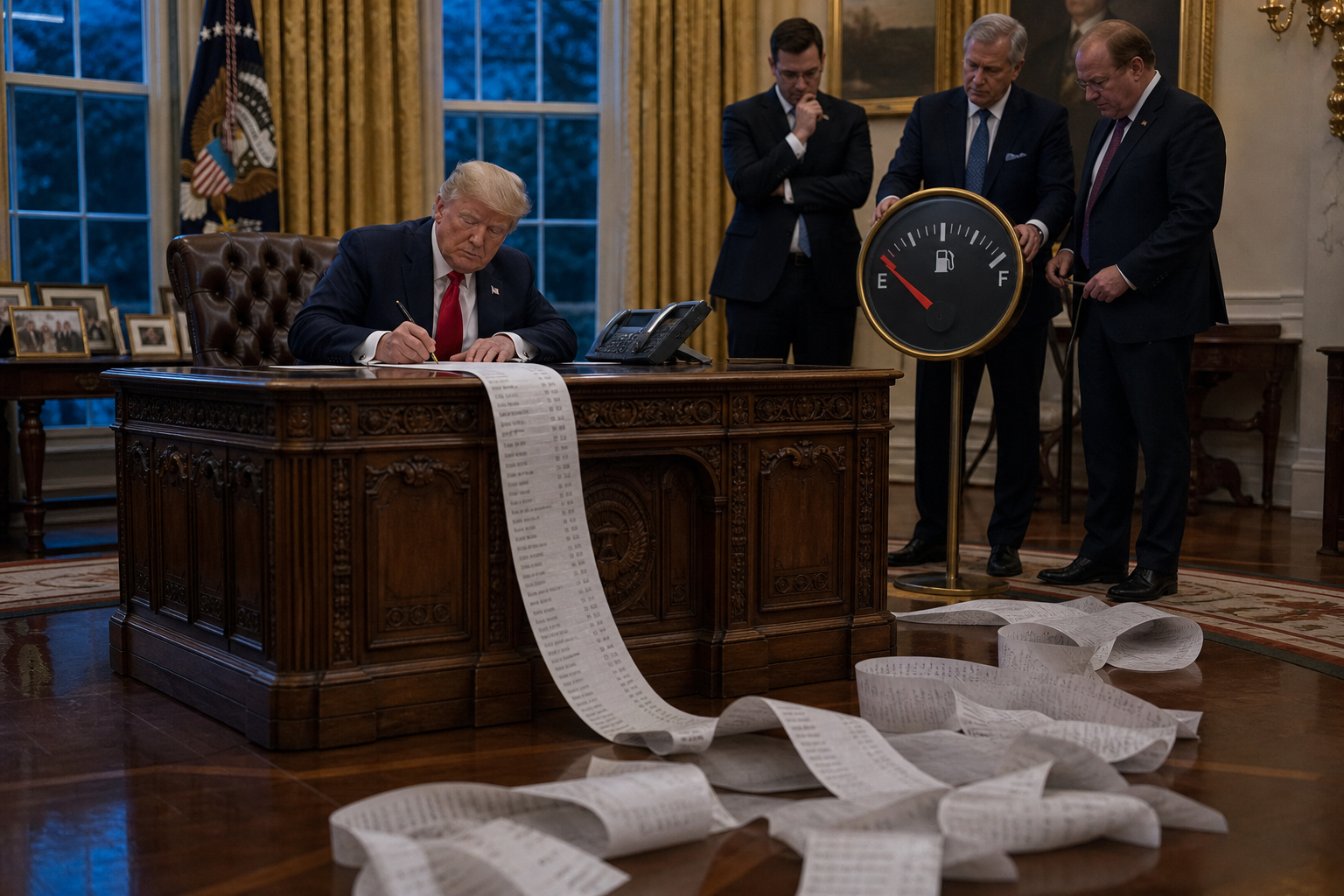
WASHINGTON— In an entirely fictional effort to clarify why a gallon of diesel now costs approximately one small inheritance, the Trump administration unveiled the Down Payment on Presidential Resolve, a new financing arrangement through which Americans may spread the cost of high energy prices over several emotionally meaningful decades.
The program follows Energy Secretary Chris Wright’s real-world explanation that President Trump understood the risks to energy flows before launching the Iran war and accepted that prices could rise in the short term. Under the White House’s fictional accounting system, that decision has been reclassified from a consequence into an asset—specifically, an asset owned almost entirely by the person who made it.
“The president made a difficult choice,” said a briefing-room display, standing beside a large ceremonial calculator with no equals sign. “Naturally, difficult choices create equity. The only question was whether that equity should belong to the president who experienced the choice, or to the people purchasing diesel for a combine at 5:40 in the morning. We think the answer is obvious.”
Participants in the program will receive an elegant monthly statement explaining that their fuel costs have been converted into a patriotic investment in executive decisiveness. A sample statement lists the price of diesel, a “regional instability adjustment,” a “leadership origination fee,” and a line marked moral principal, which cannot be paid down but may be discussed forcefully on television.
The administration stressed that no American is being asked to sacrifice. Sacrifice, officials explained, is an old-fashioned term suggesting that somebody has lost something. Under the Down Payment on Presidential Resolve, families are instead invited to build a personal relationship with the decision that made their delivery routes, heating bills, grocery costs and farm equipment more expensive.
“This is not pain,” said a fictional senior economic adviser, pointing at a chart in which every rising line ended at a portrait of Trump looking upward. “Pain is passive. This is a premium participation tier in history.”
For the first several hours, the rollout appeared to solve a longstanding political problem. Rather than deny that consumers were paying more, the White House could now argue that the payments themselves proved the president’s seriousness. If prices rose, that demonstrated resolve. If prices fell, that demonstrated mastery. If prices stayed high long enough to become their own regional weather pattern, that would demonstrate an unusually durable commitment to principle.
The trouble began when the administration’s financial engineers tried to determine who, exactly, held the debt.
At first, they assumed the burden could be bundled into Resolve-Backed Securities and sold to investors seeking exposure to American confidence. But the prospectus contained an awkward disclosure: the underlying collateral was not oil, infrastructure, or even a functioning supply chain. It was the public’s continuing willingness to be told that an expensive thing is evidence of someone else’s bravery.
That market softened immediately.
By Thursday, investors had begun asking why the president received 100% of the courage equity while diesel purchasers received a commemorative PDF congratulating them on their proximity to leadership. One analyst reportedly asked whether a household could refinance its geopolitical burden if it had good credit and no direct interest in being cast as the supporting cast of an Oval Office biography.
The White House answered with a new tool, the Resolve Affordability Calculator. Users enter their ZIP code, the size of their fuel tank and the number of times they have heard that prices will come down “before too long.” The calculator then produces a reassuring message: Congratulations. Your hardship has already been counted toward a larger historical narrative.
Officials had hoped the calculator would make the policy feel more personal. Instead, it revealed that the nation’s most expensive fuel category was not gasoline, diesel or heating oil, but unclaimed presidential virtue.
By the end of the week, administration aides were considering a modest revision: households could earn points toward lower future prices by publicly acknowledging that the president had been well aware of the risks when he created them. The points would never expire, largely because neither would the explanation.
At press time, the Down Payment on Presidential Resolve remained underwater, though the White House insisted that was simply where the energy flows were.
Trump White House Calls $6 Diesel America’s Down Payment on Presidential Resolve
In the new arrangement, the president accumulates courage equity while the country absorbs an adjustable-rate monthly payment.
WHAT STARTED THIS MESS
The event underneath the joke is real. The SPILL premise, dialogue and escalation above are fictional parody.
- MS NOW The Trump method: Lead with lies, spread them, get caught, keep lying anyway ↗
- AP Trump names national intelligence director Jay Clayton to lead a new federal AI task force ↗
- Reuters Trump names intelligence chief Clayton as AI czar, to head task force ↗
- NPR Trump names national intelligence chief Jay Clayton as new AI czar ↗
- POLITICO Trump gives spy chief new title: AI czar ↗
- PBS NewsHour Trump names national intelligence director Jay Clayton to lead a new federal AI task force - PBS ↗
- FOX Trump launching 'Super Intelligence Force' to ensure American dominance ↗
- CNN Trump announces leadership of AI task force ↗
- NBC Trump announces agreement for diesel fuel release from G7 reserves ↗
- CBS Energy Secretary Chris Wright says Trump was "well aware of the risks to energy flows" before launching Iran war ↗