Democrats Ask Unaffiliated Voters Whether They’re Seeing Anyone Else
The party’s new reconciliation strategy begins with an apology, a listening session, and absolutely no promise to stop texting.
PARODY — inspired by a real voter-registration trend.
Following signs that Democrats have regained some voter-registration ground in several key states while the unaffiliated column continues to swell like a smoke alarm nobody owns batteries for, party leaders unveiled a new initiative Thursday: asking former Democrats whether they are, in fact, seeing anyone else.
The program, called It’s Not You, It’s Our Entire Message Architecture, requires every field organizer to begin conversations with lapsed registrants by acknowledging that the relationship “became very intense around election years” and that the party may have mistaken recurring donation emails for intimacy.
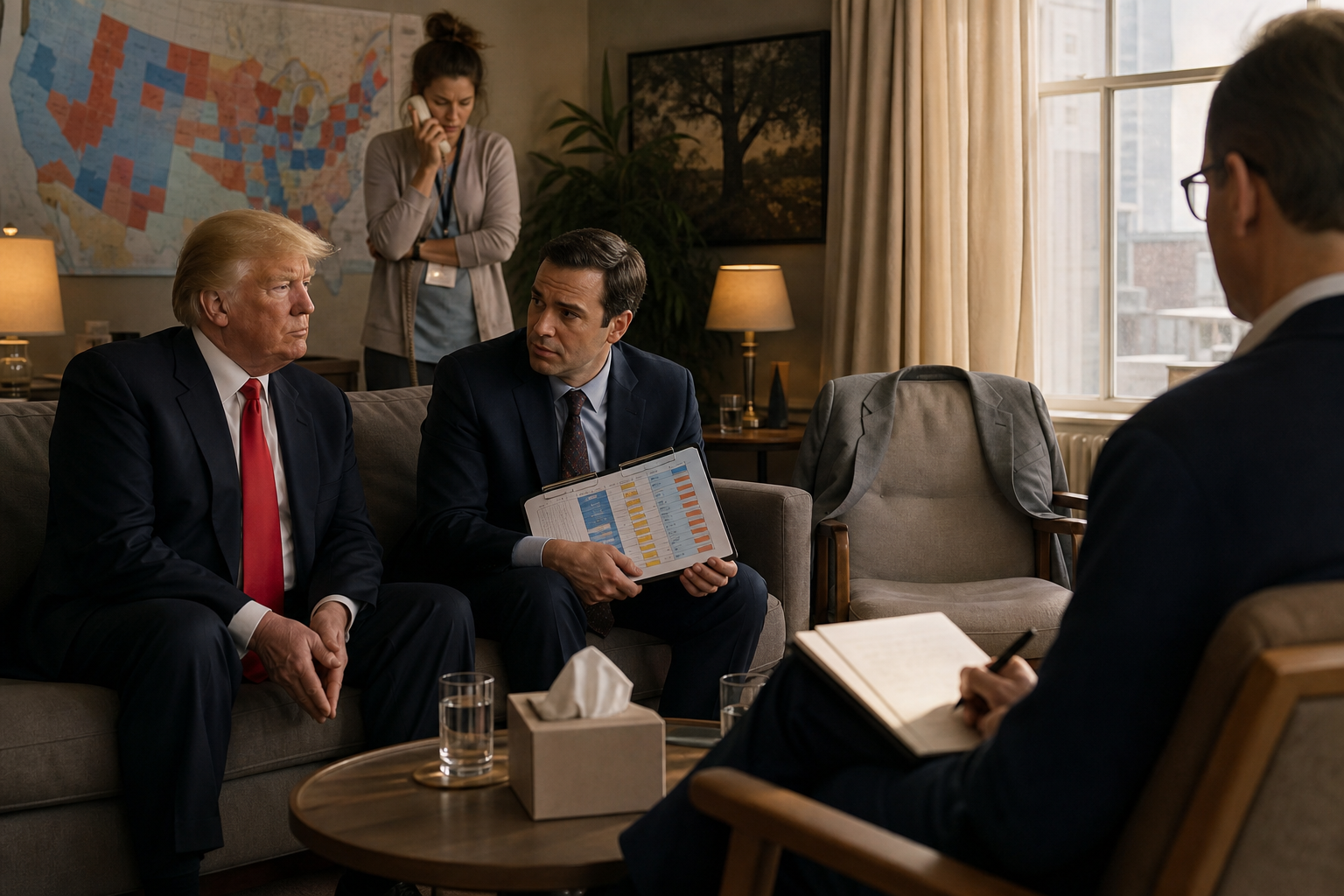
“We’re not here to pressure anyone into putting a label on things,” said a fictional Democratic consultant, seated in a beige room beside a bowl of mints and a laminated map of Pennsylvania. “We just want to understand why you changed your registration to unaffiliated after we sent twelve messages saying democracy itself had personally selected you for a $7 contribution.”
The new approach comes after Democrats reportedly improved their registration position in Arizona, Maine, Nevada, New Jersey and Pennsylvania, while slowing their declines in New Hampshire and North Carolina. Rather than celebrate the modest rebound, party strategists reportedly focused on the growing number of voters who have chosen to register with neither major party, treating each one as a former relationship whose Spotify playlist had suddenly become impossible to interpret.
Under the plan, canvassers are prohibited from opening with policy literature. Instead, they must sit quietly for up to three minutes while a voter explains that they did not “leave” the Democratic Party so much as develop an administrative need for distance.
“That’s valid,” organizers have been trained to say. “And when you say you felt unheard, do you mean generally unheard, or unheard in the particular way that made you receive a survey asking whether you preferred ‘economic populism’ or ‘protecting the soul of the republic’ before you had coffee?”
Early sessions have produced difficult truths. One fictional focus group in suburban Nevada was interrupted when a strategist asked whether participants had considered returning to the party and a woman replied, “I’m working on myself right now.” The consultant nodded solemnly, wrote potential soft support in a notebook, and asked whether she would be open to working on herself at a polling place in November.
Party officials initially believed the program was succeeding because voters described the new outreach as “less exhausting.” But a later review found that many had confused Democratic organizers with debt-relief counselors, pharmaceutical customer-service representatives, or relatives calling after an estate dispute.
The real crisis emerged when campaign analytics teams discovered that unaffiliated voters did not necessarily want a more emotionally available version of either party. Some wanted lower costs. Some wanted functional government. Some wanted candidates who could finish a sentence without turning their own biography into a fundraising link. Others simply wanted to register, vote, and avoid being greeted at the grocery store by a stranger whispering, “Have you had a chance to reflect on turnout?”
That finding triggered a brief emergency meeting in which senior operatives attempted to determine whether “functional government” could be translated into a seven-word digital ad. One consultant proposed We’ve Changed, Please Donate Before Midnight. Another suggested an interactive online quiz that would identify a voter’s attachment style, precinct, and likelihood of opening an email entitled “I’m Not Mad.”
By late afternoon, the party had reclassified its entire voter-contact operation as “reconciliation-adjacent.” Staffers were instructed to stop referring to registration switches as defections and instead call them “periods of independent exploration.” The phrase was immediately tested in three battleground states and rejected by everyone who had ever met another person.
Republicans, watching the rollout, expressed confidence that Democrats would eventually overthink a registration form until it required couples therapy, a password reset, and a donor match from someone’s emotionally complicated aunt.
Democratic leaders nevertheless defended the initiative, saying it represented a new humility after years of assuming every disappointed voter could be won back by a candidate standing beside a diner counter and saying “kitchen-table issues” with the concentration of a man defusing a bomb.
At press time, the party had scheduled a follow-up conversation with every unaffiliated voter in the country, then sent a gentle reminder that the conversation was completely optional, except for the fourteen alerts saying it was urgently needed by midnight.
Democrats Ask Unaffiliated Voters Whether They’re Seeing Anyone Else
The party’s new reconciliation strategy begins with an apology, a listening session, and absolutely no promise to stop texting.
WHAT STARTED THIS MESS
The event underneath the joke is real. The SPILL premise, dialogue and escalation above are fictional parody.