Newsom Bans Shock Gloves, Silicon Valley Calls Them Haptic Accountability
The devices are not weapons, manufacturers insist, unless the user experiences the product as intended.
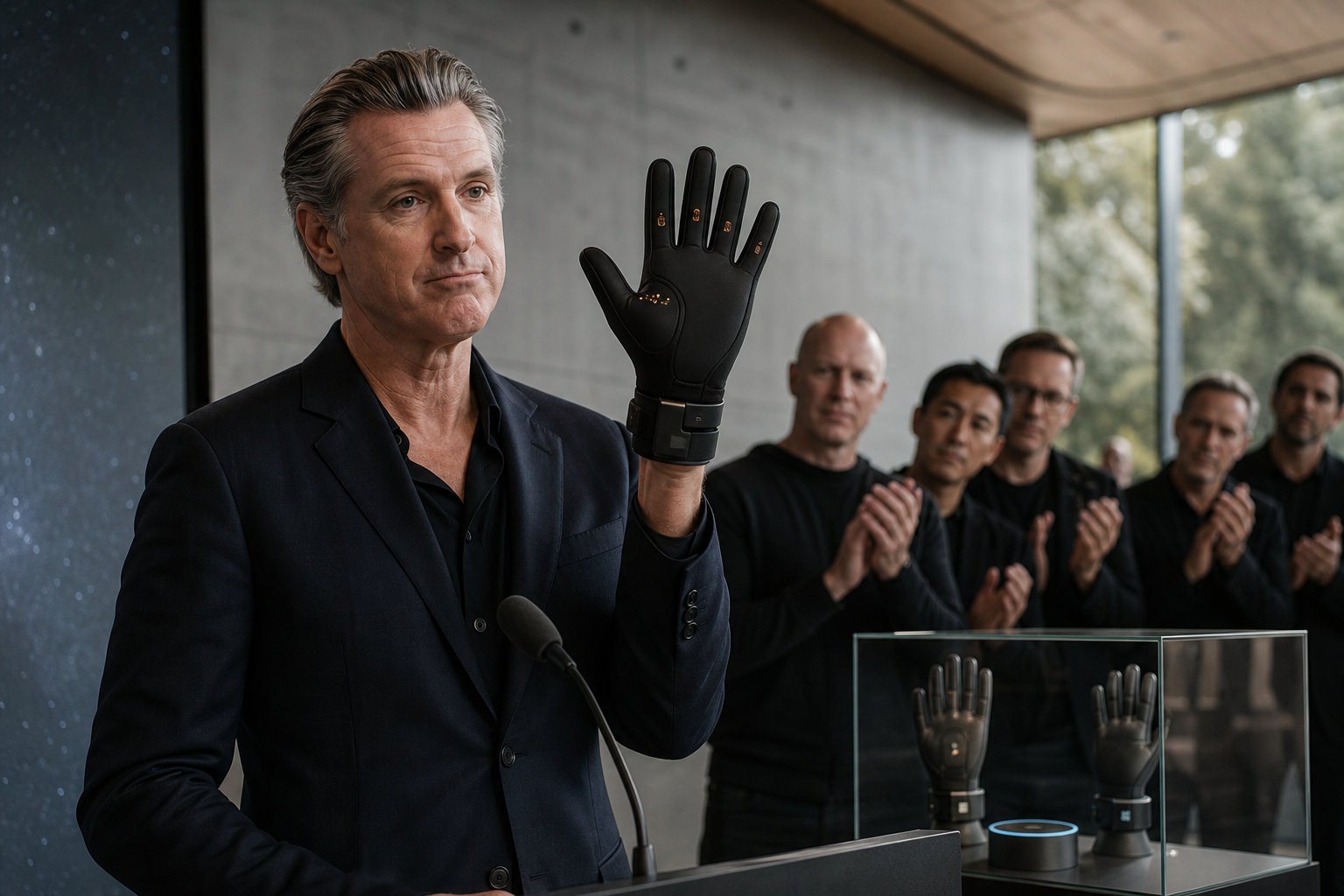
SACRAMENTO — California’s new ban on law-enforcement officers using electric-shock gloves has triggered an emergency response from the wearable-technology sector, which on Wednesday unveiled a cleaner, more future-facing name for the devices: haptic accountability interfaces.
“The phrase ‘shock glove’ is rooted in a legacy vocabulary of impact, pain and basic human alarm,” said a fictional product strategist standing beside a matte-black glove on a velvet riser. “What we offer is a hand-based communication platform that provides immediate behavioral feedback at the exact moment a person is least able to ignore it.”
The presentation, held at a San Francisco startup incubator with the architectural warmth of an expensive subpoena, was intended to reassure Californians that a glove capable of delivering an electric shock is not necessarily a glove capable of delivering an electric shock. It may also be a wellness tool, a public-safety innovation, or a subscription-service accessory with Bluetooth pairing.
Under the fictional rebrand, officers would no longer “activate” the device. They would “initiate a high-priority tactile dialogue.” The person receiving the electricity would not be “shocked.” They would be “invited into a more responsive relationship with authority.”
The company’s demonstration video showed an officer approaching a blank white silhouette labeled “uncooperative user journey.” When the glove made contact, a soft marimba chord played and an onscreen graphic announced: CONFLICT RESOLUTION: NOW 73% MORE IMMEDIATE.
California’s actual law, signed Tuesday by Gov. Gavin Newsom, bans local, state and federal law-enforcement officers from using gloves that can deliver painful electric shocks. The legislation followed concern over plans to equip immigration officers with the devices, forcing a category of product normally seen only in a low-budget action sequel to undergo the rare humiliation of being discussed in public with a straight face.
That last part has proven particularly difficult for the fictional industry coalition, Wearables for Responsible Contact, which insists the gloves have been unfairly judged by their “most memorable feature.”
“People see one tiny electrical discharge and suddenly they forget the ergonomic wrist support,” said the coalition’s imaginary president. “Nobody calls a smartphone a surveillance brick just because it can locate you, record you, sell your preferences, interrupt dinner and make your mother believe a neighborhood app post is breaking news.”
For several hours, the rebrand appeared to be working. One venture-capital panelist described the glove as “disrupting the outdated assumption that a hand is merely a hand.” Another said California’s ban could create “an opening for values-aligned alternatives,” before clarifying that those alternatives would still be gloves, still worn by officers, and still have a charging cable thick enough to tow a boat.
Then came the complication: investors learned the state had not outlawed the word “haptic.”
By lunchtime, three startups had announced companion products designed to preserve the glove’s revenue potential without its troublesome association with electricity. One offered an app that sends officers a push notification whenever they feel tempted to use force: Have you considered saying “Sir” in a lower voice? Another proposed a luxury version that delivers a mild vibration to the officer whenever a civil-rights attorney enters the room.
The most heavily funded concept was a compliance dashboard called PalmMetrics, which measures every interaction in “trust pulses.” Its initial prototype reportedly malfunctioned during a demonstration and awarded a gold badge for remaining calm while being asked whether the product could be used on a human being.
Newsom’s office did not respond to the fictional product launch, largely because it did not happen. But sources familiar with the state’s mood said California is prepared to review any future device that attempts to solve the age-old law-enforcement problem of how to make a weapon sound like a phone setting.
At the end of the event, organizers handed reporters tote bags containing a charging brick, a nondisclosure agreement and a card reading, “Power is nothing without responsible contact.” The card gave off a faint electrical hum.
Newsom Bans Shock Gloves, Silicon Valley Calls Them Haptic Accountability
The devices are not weapons, manufacturers insist, unless the user experiences the product as intended.
WHAT STARTED THIS MESS
The event underneath the joke is real. The SPILL premise, dialogue and escalation above are fictional parody.
- PBS NewsHour Newsom signs California law banning officers from using gloves that deliver electric shocks - PBS ↗
- AP California couple accused of killing son-in-law in public park have been charged with murder ↗
- CBS Newsom signs laws protecting California workers from AI risks ↗
- NBC Violence, transphobia and couple’s competing abuse claims preceded a deadly confrontation in a California park ↗
- POLITICO War of words: Newsom orders California to say AI after Trump’s ‘superintelligence’ decree ↗