Hegseth Makes Every General Defend Their Job in a 90-Second Elevator Pitch
The nation’s highest-ranking officers have been instructed to bring metrics, confidence and one devastatingly concise reason the Pacific cannot function without them.
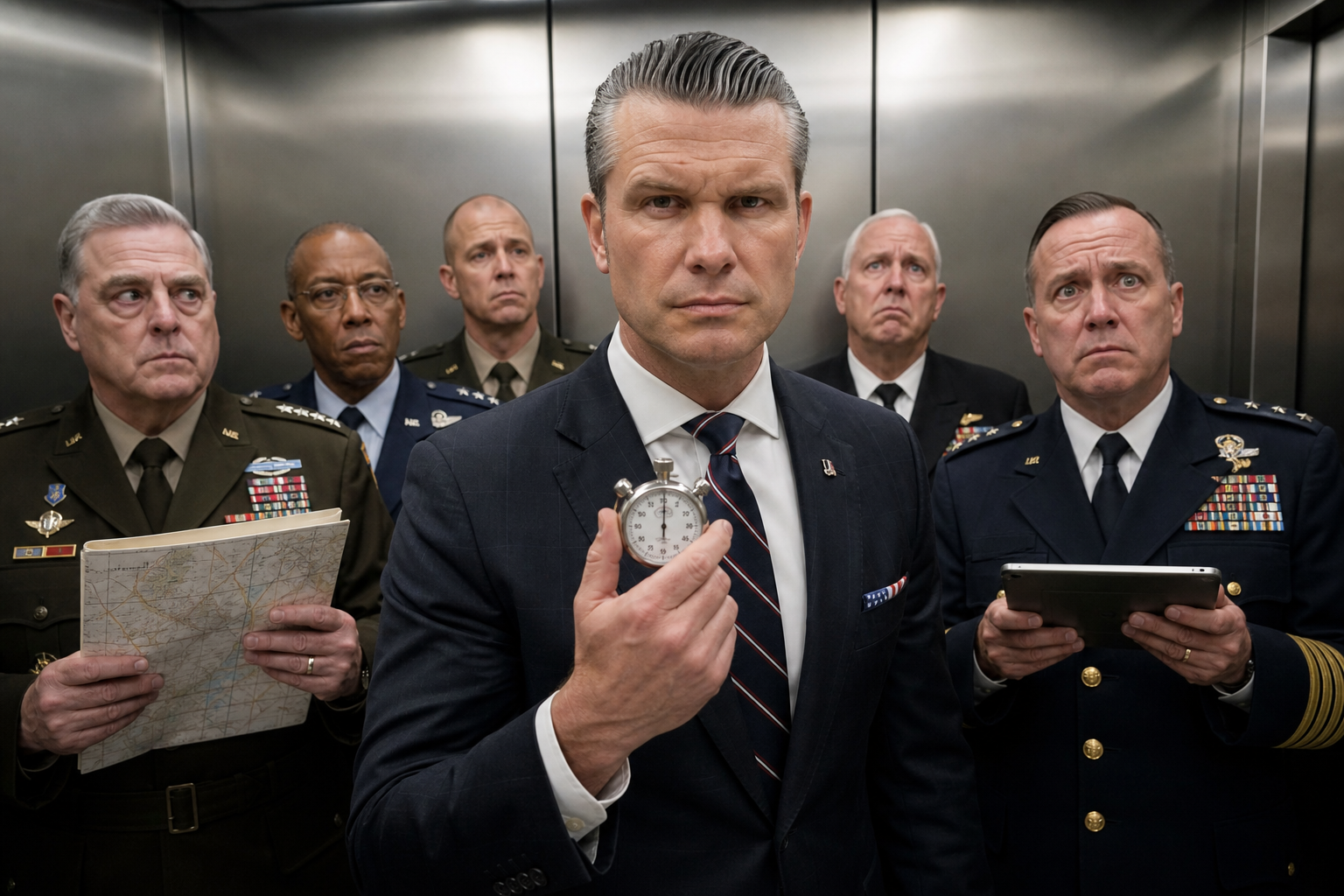
PARODY. Defense Secretary Pete Hegseth has announced that the military’s coming reduction in generals and admirals will be handled through the fairest system known to modern America: a 90-second elevator pitch delivered to a panel of people staring at their phones.
The initiative, called FLAG OFFICER VALUE PROPOSITION, gives every affected general and admiral one trip between Pentagon floors to explain why the United States cannot possibly continue without their particular blend of leadership, posture and access to a classified PowerPoint template.
“For too long, our military has allowed officers to hide behind decades of service, command experience and the vague suggestion that they know where all the missiles are,” Hegseth said in the fictional announcement. “Now they will demonstrate measurable value, like everybody else who has ever been laid off by a company that just hired a chief culture officer.”
The first round began Tuesday morning in Elevator 6, where a three-star Army general entered holding a map of the Indo-Pacific and emerged 43 seconds later with a note reading, Strong battlefield presence. Could improve cross-functional storytelling.
Several officers reportedly struggled with the format. A Navy admiral assigned to summarize maritime deterrence in a single compelling sentence used his entire allotted time explaining what an admiral is. An Air Force general brought a 64-slide deck, only to discover that the elevator’s display monitor had been reassigned to play a looping video of a motivational hawk gliding over a canyon.
“I said I oversee forces across three combatant commands,” said one fictional lieutenant general, visibly shaken after a junior consultant asked whether those forces had “considered being more nimble.” “Then she asked if my command had a mission statement that would fit on a tote bag.”
Initially, the Pentagon expected the process to identify redundant senior leadership. Instead, it discovered that every general had independently concluded that the one irreplaceable pillar of national security was a general who could translate regional deterrence into language acceptable to a panel called the Strategic Talent Elimination Cell.
That created a new problem: the officers who gave the worst pitches began surviving by embracing the standards most aggressively. One commander was praised for describing an aircraft carrier as “a premium floating platform for stakeholder reassurance.” Another received a standing ovation after referring to nuclear triad readiness as “a legacy brand with incredible omnichannel reach.”
By lunch, the military had accidentally promoted three people to “Chief Narrative Combat Officers,” a title nobody could define but nobody wanted to surrender.
The process took a darker turn when a general whose pitch focused entirely on troop readiness, logistics and alliance commitments was asked why he had not mentioned disruption. He responded that war itself was generally disruptive. The room went silent. A consultant wrote “resistance to change” beside his name and requested a follow-up elevator.
In response, officers across the Pentagon began adapting. Hallway conversations became rehearsals. Colonels lurked near espresso machines offering unsolicited advice on personal branding. The Joint Chiefs’ private dining room was transformed into a pitch lab, where senior leaders practiced describing centuries-old command structures as agile start-ups that had simply been “operating in stealth mode since 1775.”
There were complications. Elevators became impossible to book as generals attempted to engineer longer rides by pressing every button. A four-star was briefly caught riding between the basement and fifth floor for 28 minutes while trying to workshop a closing line about freedom, readiness and operational excellence. He was eventually removed by two aides and a Marine who said the building had “other vertical requirements.”
Late in the day, Hegseth’s office unveiled the final rubric: mission impact, budget discipline, leadership presence and whether the candidate could say “warfighter” without looking like they had just remembered they were in the military.
The new system’s only unquestioned success came when one admiral entered an elevator, looked directly at the panel and said, “If you cut me, nobody will know which committee is supposed to meet about the other committee.”
He was immediately retained, then assigned to chair both committees.
Hegseth Makes Every General Defend Their Job in a 90-Second Elevator Pitch
The nation’s highest-ranking officers have been instructed to bring metrics, confidence and one devastatingly concise reason the Pacific cannot function without them.
WHAT STARTED THIS MESS
The event underneath the joke is real. The SPILL premise, dialogue and escalation above are fictional parody.
- CBS Hegseth to announce a 20% cut to generals and admirals ↗
- MS NOW Hegseth to announce 20% cut to military’s top ranks ↗
- CNN Hegseth directs military to defend US midterm elections from foreign interference ↗
- AP Hegseth confirms that the US military will cut 20% of its generals and admirals ↗
- PBS NewsHour WATCH LIVE: Hegseth delivers State of the Force address, expected to make cuts to top ranks ↗