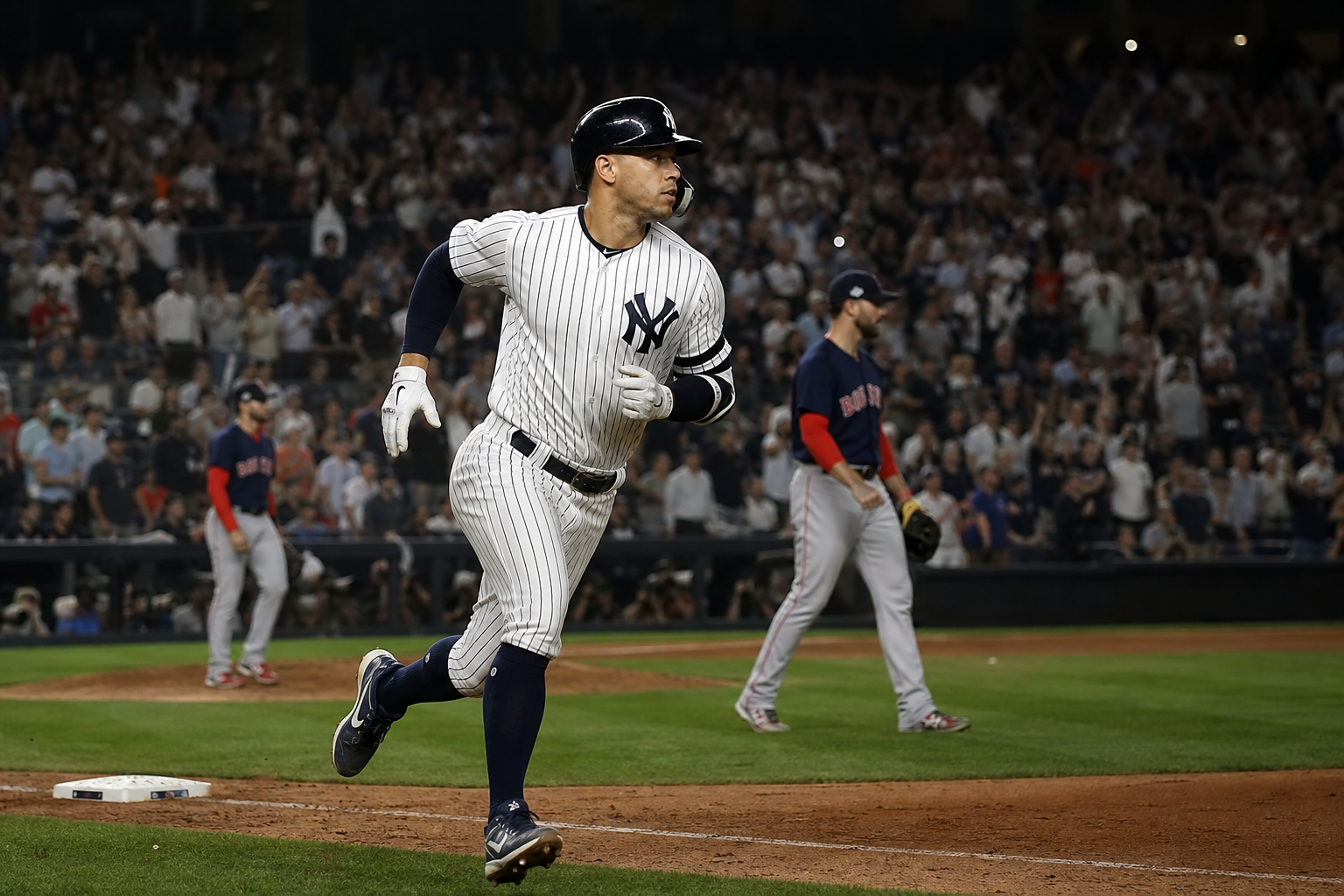
Ben Rice drove in three runs in a 9-2 nightcap win on August 29, turning a bruising day-night split into a meaningful late-season reset for New York.
NEW YORK — The New York Yankees did more than salvage a doubleheader split against the Boston Red Sox on Saturday night. Their 9-2 win at Yankee Stadium restored a three-game edge over Boston for the American League’s top wild-card position, evened the season series at six wins apiece and ensured that Sunday’s series finale would carry more than rivalry theater.
Ben Rice supplied the most visible production, going 2-for-5 with three RBIs. But the larger story was how New York recovered after a 6-0 loss in the afternoon opener: it manufactured nine runs without an extra-base hit, received a measured return from Max Fried and used a five-run eighth inning to remove any suspense after Boston had briefly narrowed the game.
That is a more useful marker than the final score alone. The Yankees did not ride one overpowering swing or a dominant complete-game pitching performance. They assembled 13 singles, drew just one walk and scored through pressure, sequencing and situational offense. In a late-August game between teams competing for the same postseason ground, that kind of response can matter as much as Rice’s headline stat line.
A game that changed in the third — and broke open in the eighth
Boston struck first when Nick Sogard led off the third inning with a home run against Fried. The Red Sox had shut out New York in the first game and, for a moment, had a chance to extend the same pattern into the nightcap.
New York’s answer was immediate. Rice tied the score with a single against Brayan Bello, Luis García Jr. brought home the go-ahead run on a bases-loaded groundout, and Jazz Chisholm Jr. added a sacrifice fly. The inning gave the Yankees a 3-1 lead, but it did not yet settle the game.
Spencer Jones added another sacrifice fly in the sixth. Boston then made it 4-2 in the eighth when Willson Contreras tripled home a run. With a runner at third and nobody out, the Red Sox had their clearest opening to turn the game into a late-inning test. Reliever Brent Headrick prevented that from happening, stranding Contreras at third.
That sequence was pivotal. Instead of entering the bottom of the eighth protecting a one- or two-run lead, the Yankees immediately created separation. Amed Rosario singled in a run, Austin Wells drove in two with another single, and Rice capped the inning with a two-run single. New York had seven hits in the frame and turned a competitive 4-2 game into a seven-run margin.
The box score captures the unusual shape of the offense: all 13 Yankee hits were singles. García had three hits; Rice, Rosario and José Caballero had two apiece. New York also scored on two sacrifice flies. The approach did not depend on waiting for a home run in a stadium often associated with them. It depended on converting contact into sustained innings.
Fried’s return offered encouragement, not a finished answer
Fried’s first start since August 13 was necessarily limited. Returning from a second injured-list stint for a bone bruise in his left elbow, he threw 63 pitches over 3 2/3 innings, allowing one run and three hits while striking out four and walking one.
That outing should not be overstated as proof that the Yankees’ rotation questions are solved. Fried did not work deep enough to qualify for the win, and the bullpen still needed to cover 5 1/3 innings. But the immediate evidence was positive: Boston managed only Sogard’s solo homer against him, and Fried left with New York ahead.
Paul Blackburn earned the victory with a scoreless sixth inning after relieving Tyler Danish, while the Yankees’ bullpen collectively held Boston to two runs on six hits. The result kept the focus on Fried’s health where it belongs: his return gives New York another potentially consequential option, but his workload and effectiveness over subsequent starts will be more telling than one abbreviated appearance.
Why the split matters more than a split usually does
Saturday offered two sharply different versions of the Yankees. In the opener, Boston won 6-0, punctuating the game with a four-run ninth inning. In the nightcap, New York answered with consistent offense and preserved its edge in the wild-card race.
At the end of the second game, the Yankees were 77-59 and the Red Sox were 74-62. That three-game margin is meaningful, but not secure with roughly a month remaining in the regular season. The teams had also split their first 12 meetings, making Sunday, August 30, the final contest of the four-game series and the game that will decide the season series.
Boston is scheduled to start left-hander Ranger Suárez, listed at 5-3 with a 3.35 ERA entering the game. New York is scheduled to counter with right-hander Will Warren, listed at 8-6 with a 4.39 ERA. The pitching matchup presents a different test from Saturday night: the Yankees’ right-handed hitters may have a greater role against Suárez, while Warren will be asked to provide length after a doubleheader that required extensive pitching coverage.
What to watch next
First is George Lombard Jr.’s right knee. The 21-year-old rookie shortstop left the nightcap after the third inning after appearing to tweak the knee on a check swing in the second. The Yankees had not established the severity of the issue in the immediate aftermath, so his availability for Sunday and beyond remains unresolved.
Second is whether New York can turn one productive night into a repeatable offensive formula. The Yankees have now scored at least seven runs in four of their last seven games, according to the AP report. Saturday’s game showed a lineup capable of scoring without waiting for power. The remaining question is whether it can sustain that approach against Boston’s left-handed starter in the finale.
For one night, the Yankees replaced the frustration of the opener with a cleaner, deeper response. It tightened the race’s immediate math in their favor. It did not end the competition with Boston — it set up the final game of the season series to define it.