Preliminary official results show Icelanders rejected reopening EU accession talks, 52.8% to 47.2%. The referendum did not decide whether Iceland will join the European Union, and it leaves the country’s existing ties to Europe intact.
Iceland’s referendum on the European Union has produced a clear preliminary winner: the “No” side. But the most important fact about the Aug. 29 vote is also the one most easily lost in the headline shorthand: Icelanders did not vote on whether to join the EU.
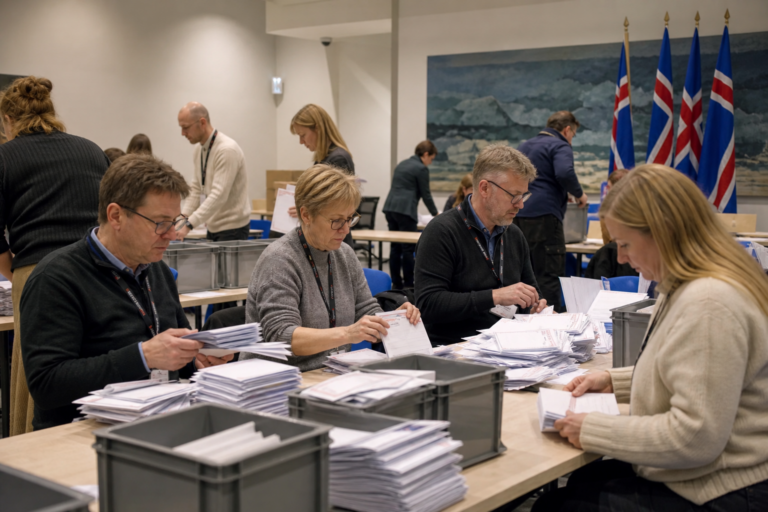
They voted on whether to restart accession negotiations that have been dormant for more than a decade. According to vote-counting results released Aug. 30 by Iceland’s National Electoral Commission, 118,040 voters — 52.8% of valid ballots — opposed reopening the talks. The “Yes” side received 105,339 votes, or 47.2%. Turnout was 82.6%, with 225,031 ballots cast from 272,591 registered voters.
The commission said it had received reports from all constituency election authorities but had not yet formally declared the final result, because it must first rule on any disputed ballots. That distinction is procedural, not cosmetic: the reported margin is nearly 12,701 valid votes, while the commission said its eventual ruling could affect the final count.
What voters actually rejected
The question was simple: whether Iceland should resume accession negotiations with the European Union. Iceland applied to join in 2009, began negotiations, and put them on hold after a change of government in 2013. Its application was never formally withdrawn.
A “Yes” would have authorized a return to negotiations, not automatic entry into the 27-nation bloc. Those talks would have required Iceland and EU institutions to settle difficult policy questions, including fisheries. Any eventual membership agreement would have been a separate political and legal decision, not the direct result of Saturday’s referendum.
That makes descriptions of the result as Iceland voting to “stay out” of the EU incomplete. The vote blocks a new negotiating phase for now; it does not itself settle every future membership question. It also does not remove Iceland from the European Economic Area or the Schengen travel area — arrangements through which Iceland already participates in much of Europe’s internal market and free-movement framework while remaining outside the EU’s political institutions.
Why fisheries outweighed a security argument
The referendum combined two very different anxieties. Supporters of renewed talks argued that a closer relationship with Europe could give Iceland more economic and geopolitical stability at a moment of uncertainty around the Arctic and NATO. Opponents argued that entering negotiations could jeopardize national control over fisheries, a foundational Icelandic industry, and dilute sovereignty over policy already handled domestically.
The preliminary map of the vote shows the tension between those cases. Reykjavík was the only area where a majority backed reopening negotiations, according to reporting by The Associated Press. The national result instead reflected stronger skepticism outside the capital, where the fisheries question carried particular weight.
The concern was not abstract. Fisheries negotiations never reached a conclusion during Iceland’s 2009-2013 accession process, according to a European Parliament research briefing. Agriculture was another unresolved chapter. A new negotiating process might have clarified what exemptions or transition terms Iceland could secure, but it could not have guaranteed them. Voters were therefore being asked whether to reopen an uncertain process, rather than approve a finished agreement.
Trump and Greenland: a real factor, but not the whole explanation
Reporting before the vote described President Donald Trump’s stated interest in obtaining U.S. control of Greenland as an important backdrop. Greenland is a self-governing territory within the Kingdom of Denmark, a NATO ally, and lies about 180 miles from Iceland at its nearest point. Icelandic supporters of renewed EU talks said Trump’s rhetoric raised uncomfortable questions about whether the country needed stronger European political ties.
The evidence supports treating Greenland as a meaningful campaign issue, not as a complete explanation for the referendum or its outcome. Iceland’s governing coalition committed to holding an EU-talks referendum when it formed in December 2024, well before the final campaign. The Althing approved the referendum resolution on May 27, 2026. Trump’s Greenland push appears to have sharpened an existing debate over security and alignment; it did not create Iceland’s longer-running conflict over EU membership, fisheries and national authority.
That distinction matters for U.S. readers. A foreign-policy dispute can influence domestic politics abroad without producing a simple referendum on Washington. Iceland’s vote was not an endorsement of Trump’s Greenland position, nor was it a vote against European security cooperation. Iceland remains a NATO member and retains its existing institutional relationships with the EU.
What happens next
First, Iceland’s National Electoral Commission must formally certify the referendum result after its review of disputed ballots. The preliminary tally strongly indicates that negotiations will not resume under this referendum.
Second, Prime Minister Kristrún Frostadóttir’s government must decide how it frames the defeat. The result does not require Iceland to weaken its EEA, Schengen, NATO or bilateral EU cooperation. It does mean the government lacks public authorization for the specific step it proposed: reopening accession talks.
Finally, the vote puts a practical limit on claims that Arctic insecurity alone can shift Iceland toward full EU membership. Nearly half of valid voters backed renewed talks, a substantial constituency. But the larger bloc concluded that the case for reopening the process was not yet strong enough — even amid heightened concern about Greenland and the future of transatlantic relations.
The immediate verdict is therefore narrower than either side’s broadest political narrative. Iceland has rejected a negotiating mandate, not made a final decision on EU membership or its Western alliances.