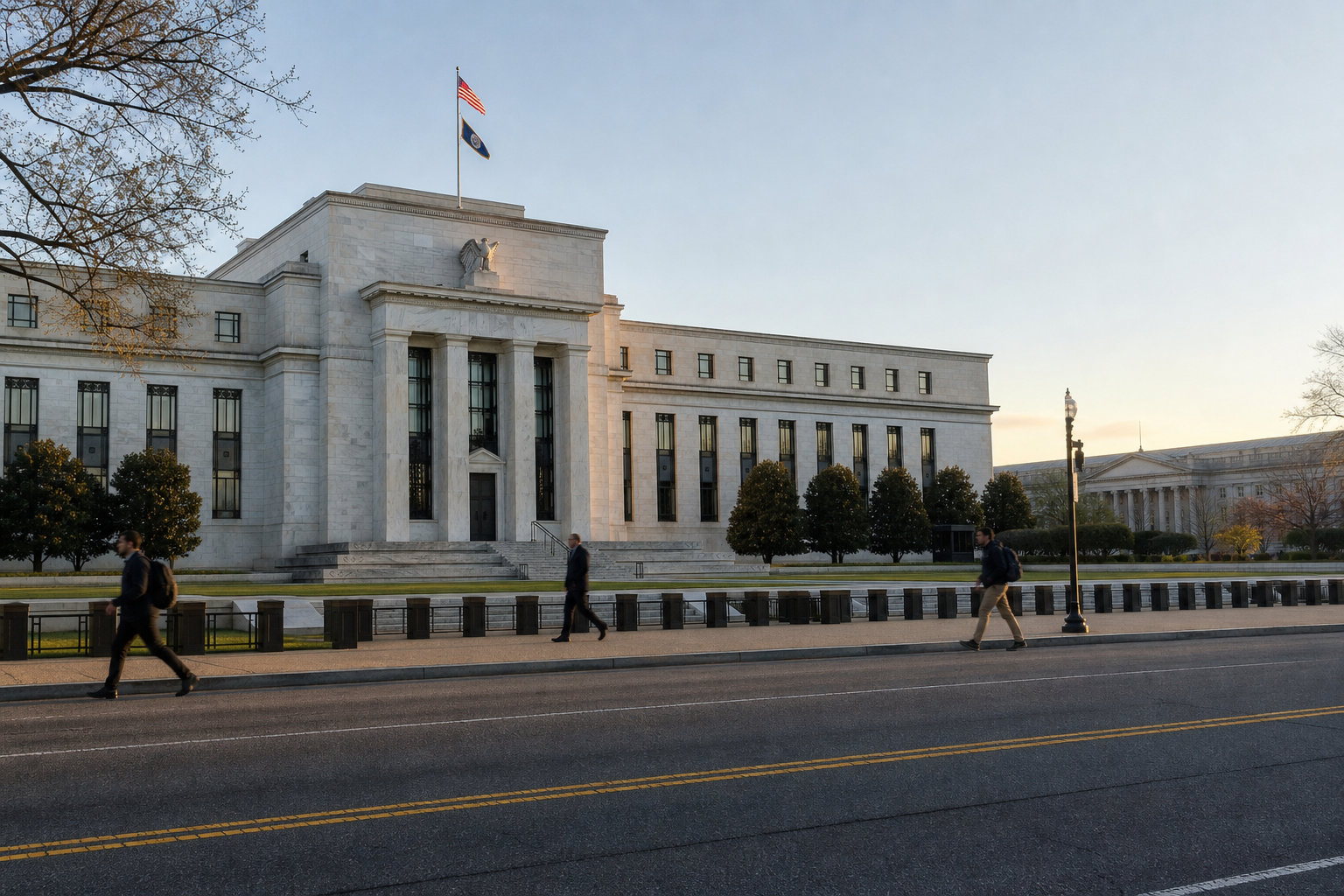
The Fed chair’s Jackson Hole speech sharpened the inflation case for tighter policy, but the September 15-16 decision belongs to the full FOMC—not the president or the chair alone.
Federal Reserve Chair Kevin Warsh did not announce a rate increase at Jackson Hole. He did something more consequential for the next meeting: he set a standard that makes a hike easier to justify.
In his August 28 speech, Warsh said inflation remained above the Fed’s 2 percent target and that policymakers must be confident underlying inflation is returning to that goal “clearly and at sufficient speed.” Otherwise, he said, “we have work to do.” He ended with a pointed distinction: he was committed to a discipline, “not to a decision.” (federalreserve.gov)
That is not a promise to raise rates when the Federal Open Market Committee meets September 15-16. It is, however, a public warning that holding the federal-funds target at its current 3.50 percent to 3.75 percent range will require evidence that inflation is convincingly improving.
President Donald Trump responded on August 31 by saying rates are too high while also saying Warsh would “do what he has to do.” The statement is a notable change in tone from a president who has repeatedly pressed for lower borrowing costs. But the record matters more than the phrasing: Trump does not set the federal-funds rate, and Warsh cannot set it unilaterally either. The rate decision is made through an FOMC vote. (investing.com)
What Warsh’s speech actually said
The central factual claim emerging from Jackson Hole is that Warsh signaled a September hike. That claim is supported, with an important qualification. He did not commit to one, and he explicitly rejected routine forward guidance. But his stated test—credible, sufficiently fast movement toward 2 percent inflation—was paired with an assessment that the economy has strengthened, business investment is rising and financial conditions do not appear especially restrictive. (federalreserve.gov)
The recent inflation data give that position a factual basis. The Bureau of Economic Analysis reported that the personal-consumption-expenditures price index rose 3.7 percent over the 12 months through July, while core PCE, which excludes food and energy, rose 3.3 percent. Both were above the Fed’s 2 percent inflation objective. (bea.gov)
The Consumer Price Index told a somewhat less severe, but still above-target, story: headline CPI rose 3.4 percent over the year through July and core CPI rose 2.5 percent. The measures are not interchangeable; they cover inflation differently, and the Fed formally targets PCE. Still, neither release supplies an obvious all-clear for a central bank that says price stability is its first concern. (bls.gov)
The vote count is the clearest sign of pressure
The more concrete warning for borrowers came before Jackson Hole. At its July 28-29 meeting, the FOMC voted 9-3 to hold rates steady. The three dissenters preferred an immediate quarter-point increase. The minutes said most participants wanted more information, while several saw broad enough price pressure to warrant a more restrictive stance. (federalreserve.gov)
That split means a rate increase is not merely a market-theory exercise. At least three voting members had already concluded that the case had been met in July. Warsh’s Jackson Hole message did not reveal whether he will join them in September; it did state a framework compatible with their concern.
It also establishes a guardrail around the political framing. Trump’s acceptance of a possible hike does not create one, and presidential objections would not formally prevent one. The meeting’s official statement will reflect the FOMC’s collective decision, with Warsh casting one vote among the committee’s voters. The July result shows why that distinction is more than civics-class fine print: the committee can disagree openly with its chair and with the White House’s preferred direction.
A Treasury move is being overstated
One potentially confusing part of the Jackson Hole discussion concerns the Treasury Department’s long-dated bond buybacks. In the PBS discussion following Warsh’s speech, Treasury Secretary Scott Bessent’s plan was described as an intervention intended to bring down yields. The official Treasury announcement does not say that.
Treasury said on August 19 that it would at least double the maximum size of certain long-end liquidity-support buybacks, from $2 billion to at least $4 billion per operation, beginning September 9. Its stated reason was to provide greater liquidity support in sectors where it has received substantial high-quality offers. The release did not describe the policy as a campaign to cap borrowing costs or counteract Fed policy. (home.treasury.gov)
That makes the stronger characterization unsupported by the primary record so far. Buybacks can affect market conditions at the margin, especially in the securities being purchased. But Treasury’s stated liquidity rationale is not the same as an announced effort to force down long-term rates. Whether the expanded operations materially move yields, or complicate the Fed’s reading of financial conditions, remains an empirical question—not an established fact.
Warsh’s own speech makes that question worth watching. He said the Fed needs market signals “as unfiltered as possible,” including Treasury prices, yields, credit availability and the dollar. If Treasury operations noticeably alter long-end market pricing, Fed officials will have to judge whether they are seeing underlying investor demand, a liquidity effect, or both. (federalreserve.gov)
What will decide September
The next meeting is September 15-16. Policymakers will receive the August employment report on September 4 and August CPI data on September 11 before they gather. They will not have the August PCE report beforehand: BEA has scheduled that release for September 30. (bls.gov)
For households, the stakes are immediate. A hike could further raise the cost of variable-rate debt and put upward pressure on new mortgages, auto loans and business credit. A decision to hold would avoid that near-term increase but could deepen doubts about whether the Fed is responding quickly enough if inflation stays elevated.
Warsh has now made the evidence threshold explicit. The September question is not whether Trump is comfortable with a hike. It is whether a voting majority on the FOMC concludes that the data meet Warsh’s own warning: that inflation has not moved toward 2 percent with enough clarity or speed to justify waiting.


