Democrats want to center November’s campaign on the economy and President Donald Trump, but disagreements over Senate nominee Abdul El-Sayed, Israel and online commentator Hasan Piker are keeping internal tensions in view.
Michigan Democrats are trying to redirect their campaign message toward the economy and President Donald Trump ahead of November’s election. First, they must manage divisions that have persisted since Abdul El-Sayed’s Senate primary win earlier this month.
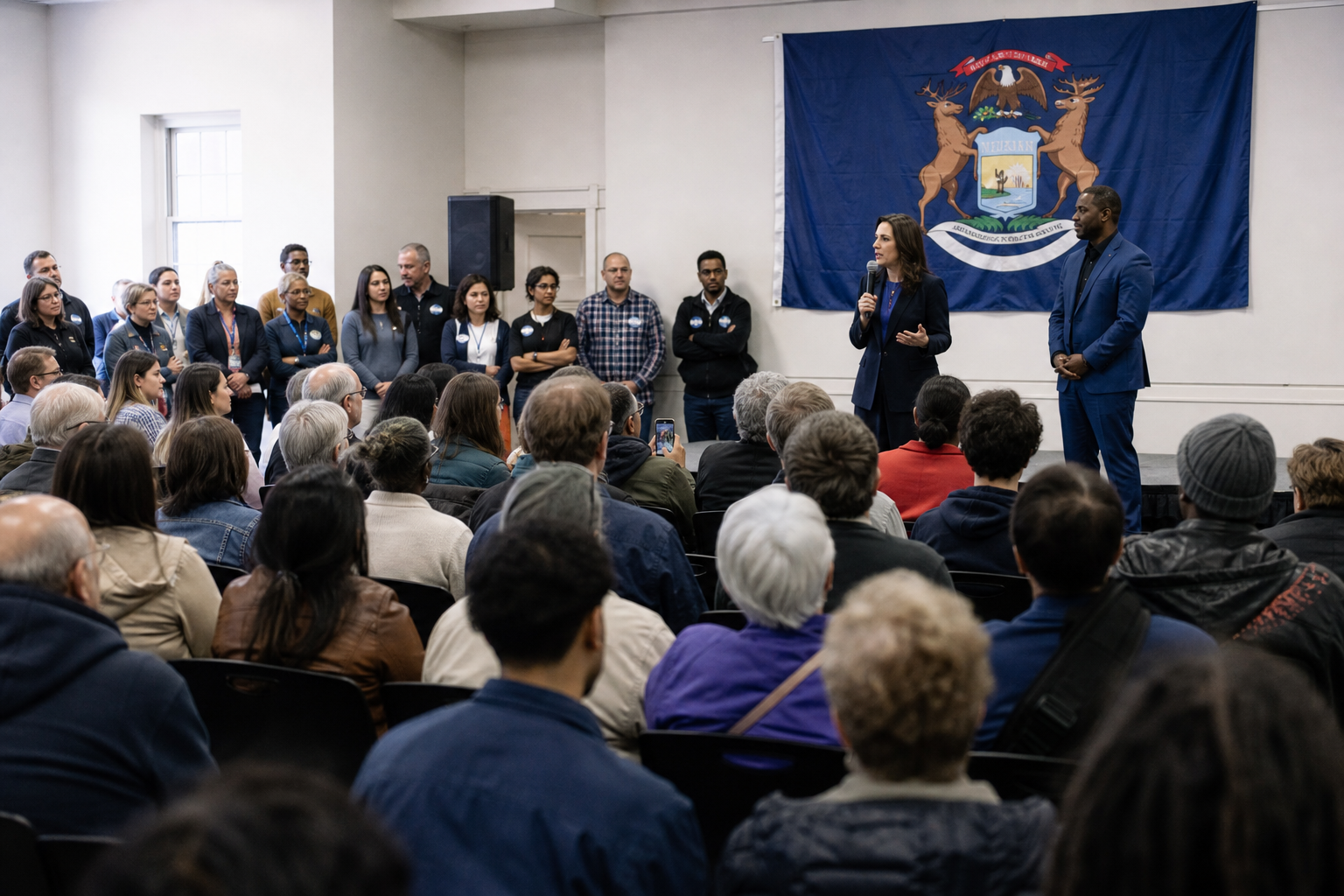
The tension surfaced at a West Michigan gathering this week in a congressional district Democrats hope to win. What began as a discussion of cost-of-living concerns shifted to criticism of U.S. Rep. Hillary Scholten, who has not endorsed El-Sayed.
El-Sayed, who would be the first Muslim U.S. senator, has condemned antisemitism while also sharply criticizing Israel’s military campaign in Gaza. Some Democrats, including Scholten and state Rep. Jeremy Moss, have withheld support as questions about his rhetoric and his campaign-trail association with streamer Hasan Piker continue to divide party figures.
Piker has drawn criticism for past remarks and for comments that critics said suggested Jewish Americans who strongly identify with Israel could invite violence. He rejected that interpretation, saying he was warning against broadly associating American Jews with the actions of the Israeli government. El-Sayed has said that only he and his campaign spokesperson speak for his campaign, but he has not fully severed ties with Piker.
Michigan Attorney General Dana Nessel, speaking separately to The Atlantic, said El-Sayed should not excuse domestic terrorism, referring to remarks he made after an attack on a synagogue outside Detroit. El-Sayed has expressed frustration that the campaign’s attention has remained on Piker and the primary’s fallout rather than the general-election contest against Republican Mike Rogers.
Other Democrats are urging the party to move on. Rep. Debbie Dingell said the November race should not revolve around Piker, while Rep. Jamie Raskin described the tensions as part of the difficult process of unifying after a competitive primary.
Michigan Democrats are expected to meet in Lansing this weekend to finalize their ticket. Party nominees and Chair Curtis Hertel have issued a message against disruptive behavior and harassment as they seek to present a more unified front.